Flavor← the wheel
Duck
Meat, fish & cheese· meat
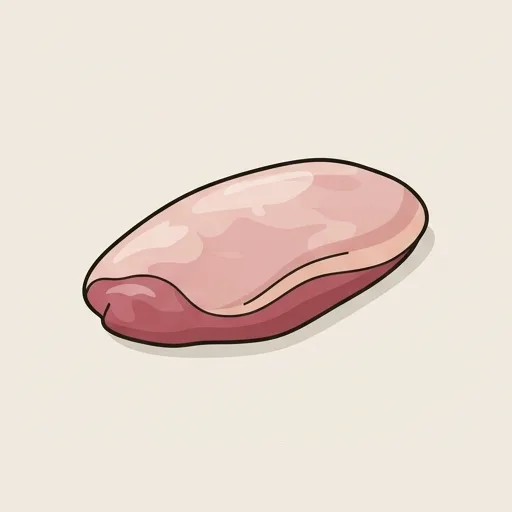
What it is
Duck is the meat of domesticated waterfowl, most commonly the Pekin duck, Anas platyrhynchos domesticus.
What it tastes like
On the nose: fatty, orange-rose. Among its measured molecules: 2,4-decadienal, pentanal, 2-Nonenal, 2-amylfuran, 2-Octenal.
What goes with it
- Rooibosboth carry 1-octen-3-ol, mushroomcite
- Duck fatboth carry 1-octen-3-ol, mushroomcite
- Grilled beefboth carry heptanal, fattycite
Salt and acid
Salt
Salt not measured yet.
Acid
Acid not measured yet.
Unusual pairings
Pairs the library can cite that almost nobody makes.
- Duck + Jalapeño
both carry 1-octen-3-ol, mushroom (53 of 338 carry it)
- Duck + Walnut
both carry 1-octen-3-ol, mushroom (53 of 338 carry it)
- Duck + Rooibos
both carry 1-octen-3-ol, mushroom (53 of 338 carry it)
Every one of its 11 compounds carries a paper the library can cite.
benzaldehydearomaaldehydereads as burning aromatic taste (PubChem)Measured in 54 of 338 ingredients.cite
0.79% (SG) vs 1.5% (FG); descriptor 'Almond' — Weng et al. 2022, Foods (Table 5, row 'Benzaldehyde')caprylaldehydearomaaldehydereads as strong, fruity odor (PubChem)Measured in 37 of 338 ingredients.cite
7.03% (SG, significantly higher, P<0.05) vs 4.39% (FG); descriptor 'Fruity, sour' — Weng et al. 2022, Foods (Table 5, row 'Octanal')hexanalaromaaldehydereads as sharp, aldehyde odor (PubChem)Measured in 85 of 338 ingredients.cite
39.29% (SG, Liancheng White) and 40.57% (FG, Cherry Valley) of total volatile contribution -- the single largest compound in raw duck breast in both breeds, no significant breed difference; the paper's own descriptor column reads 'Green, grass' — Weng et al. 2022, Foods (Table 5 (contribution rates of volatile compounds, %), row 'Hexanal')pentanalaromaaldehydereads as it has sharp, penetrating flavor (PubChem)Measured in 15 of 338 ingredients.cite
heptanalaromaaldehydereads as fatty taste (PubChem)Measured in 33 of 338 ingredients.cite
3.64% (SG) vs 3.11% (FG); descriptor 'Cheesy, fatty' — Weng et al. 2022, Foods (Table 5, row 'Heptanal')1-octen-3-olaromaalcoholMeasured in 35 of 338 ingredients.cite
0.45% (SG) vs 5.77% (FG, significantly higher, P<0.05, roughly 13-fold) -- the compound the paper's own abstract names directly: 'FG meat had a mushroom note resulting from higher octenol'. Identified as 1-octen-3-ol on the strength of that mushroom descriptor, the textbook character of this compound — Weng et al. 2022, Foods (Table 5, first row labelled 'Octenol', descriptor 'Mushroom')2-amylfuranaromafuranMeasured in 23 of 338 ingredients.cite
4.21% (SG) vs 4.18% (FG), essentially breed-independent; descriptor 'Metallic, green, earthy, beany' — Weng et al. 2022, Foods (Table 5, row 'Furan, 2-pentyl-')nonanalaromaaldehydereads as orange-rose odor (PubChem)Measured in 59 of 338 ingredients.cite
12.65% (SG, significantly higher, P<0.05) vs 8.81% (FG); descriptor 'Green, stale'. The paper attributes the SG-vs-FG difference to lower carnitine content in SG meat promoting lipid deposition that yields more nonanal and octanal — Weng et al. 2022, Foods (Table 5, row 'Nonanal')2-OctenalaromaaldehydeMeasured in 23 of 338 ingredients.cite
2.51% (SG, significantly higher, P<0.05) vs 1.29% (FG); descriptor 'Fatty' — Weng et al. 2022, Foods (Table 5, row 'Octenal')2-NonenalaromaaldehydeMeasured in 20 of 338 ingredients.cite
0.65% (SG) vs 0.39% (FG); descriptor 'Fishy, tallow' — Weng et al. 2022, Foods (Table 5, row 'Nonenal')2,4-decadienalaromaaldehydeMeasured in 12 of 338 ingredients.cite
0.57% (SG) vs 0.26% (FG); descriptor 'Fatty, meat' -- one of the few compounds in this table the paper's own descriptor column ties directly to a meaty rather than fatty-generic note — Weng et al. 2022, Foods (Table 5, row 'Decadienal')
Sources
- Weng et al. 2022, Foods