Rooibos
Sweet & rich· tea coffee cacao
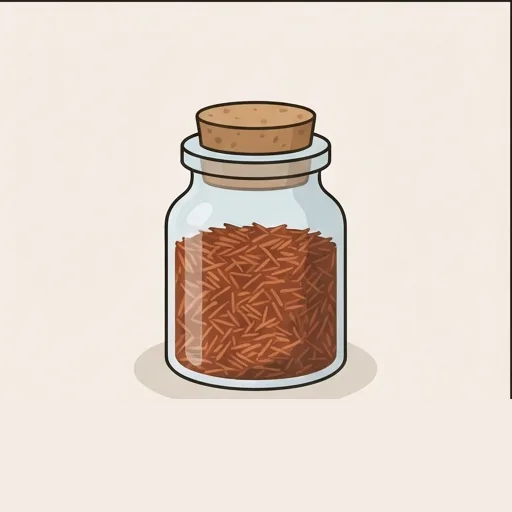
What it is
Rooibos is a South African plant, Aspalathus linearis, whose needle-like leaves are fermented and dried to make a tisane unrelated to Camellia sinensis, the tea plant.
What it tastes like
On the nose: citrus; the house adds honeyed, woody, gentle tea ✳. Among its measured molecules: methylheptadienone, (Z)-2-Heptenal, 1-octen-3-one, (E,Z)-2,6-nonadienal, trans-2-decenal.
What goes with it
- Duckboth carry 1-octen-3-ol, mushroomcite
- Calamansiboth carry caprylaldehyde, fruitycite
- Sweet orangeboth carry caprylaldehyde, fruitycite
Salt and acid
Salt
Salt not measured yet.
Acid
Acid not measured yet.
Unusual pairings
Pairs the library can cite that almost nobody makes.
- Rooibos + Cape gooseberry
both carry 1-octen-3-ol, mushroom (53 of 338 carry it)
- Rooibos + Oregano
both carry 1-octen-3-ol, mushroom (53 of 338 carry it)
- Rooibos + Calamansi
both carry caprylaldehyde, fruity (63 of 338 carry it)
25 of 130 compounds on file carry a paper the library can cite.
caprylaldehydearomaaldehydereads as strong, fruity odor (PubChem)Measured in 37 of 338 ingredients.cite
hexanalaromaaldehydereads as sharp, aldehyde odor (PubChem)Measured in 85 of 338 ingredients.cite
identified by GC-MS/retention-index matching (RIcal 1060 vs. RIlit 1083) in a green-rooibos-extract iced-tea powder reconstituted in water before storage; no peak-area/concentration value given — Human et al. 2021, Molecules (Table 4 'Volatile compounds tentatively identified... for M3 reconstituted in water, before storage')linaloolaromaalcoholreads as spicy, citrus taste (PubChem)Measured in 91 of 338 ingredients.cite
identified (RIcal 1526 vs. RIlit 1547); text notes linalool is among terpenes/aldehydes likely to decrease on storage via oxidation on contact with air — Human et al. 2021, Molecules (Table 4; Results text)6-methyl-5-hepten-2-onearomaketonereads as fruity taste (PubChem)Measured in 15 of 338 ingredients.cite
identified (RIcal 1316 vs. RIlit 1338); text: '...the other ketones, 6-methyl-5-hepten-2-one (12) and 6-methyl-3,5-heptadien-2-one (20), all major compounds in rooibos infusions and in the current samples, increased' on storage — Human et al. 2021, Molecules (Table 4; Results text)1-octen-3-olaromaalcoholMeasured in 35 of 338 ingredients.cite
2-amylfuranaromafuranMeasured in 23 of 338 ingredients.cite
limonenearomaterpenoidreads as pleasant lemon-like (PubChem)Measured in 91 of 338 ingredients.cite
myrcenearomaterpenoidreads as pleasant (PubChem)Measured in 68 of 338 ingredients.cite
identified (RIcal 1129 vs. RIlit 1161); text notes beta-myrcene decreased on storage, consistent with oxidation of 'electron-rich volatile compounds, such as terpenes and aldehydes' — Human et al. 2021, Molecules (Table 4)1-octen-3-onearomaacidMeasured in 6 of 338 ingredients.cite
identified (RIcal 1278 vs. RIlit 1300); text: 'The ketone, 1-octen-3-one (10)... decreased' on storage; described as one of the major compounds in rooibos infusions — Human et al. 2021, Molecules (Table 4; Results text)isoorientintasteflavonoidMeasured in 1 of 338 ingredients.cite
Green rooibos: 1.068 g/100g dried infusion (0.0114 mg/mL). Fermented rooibos: 1.205 g/100g (0.0097 mg/mL) — Simpson et al. 2013, Molecules (Table 2, row 'Iso-orientin')(E,Z)-2,6-nonadienalaromaaldehydeMeasured in 8 of 338 ingredients.cite
identified (RIcal 1566 vs. RIlit 1584); named in the abstract among compounds associated with 'green-like' aromas that decrease with storage — Human et al. 2021, Molecules (Table 4; Abstract)geranylacetonearomaketoneMeasured in 9 of 338 ingredients.cite
vitexintasteflavonoidMeasured in 1 of 338 ingredients.cite
Green rooibos: 0.173 g/100g dried infusion (0.0018 mg/mL). Fermented rooibos: 0.217 g/100g (0.0017 mg/mL) — Simpson et al. 2013, Molecules (Table 2)rutintasteflavonoidMeasured in 3 of 338 ingredients.cite
Green rooibos: 0.404 g/100g dried infusion (0.0043 mg/mL). Fermented rooibos: 0.064 g/100g (0.0005 mg/mL) — Simpson et al. 2013, Molecules (Table 2)2-HexenalaromaaldehydeMeasured in 31 of 338 ingredients.cite
identified (RIcal 1196 vs. RIlit 1213); named in the abstract among the compounds associated with 'green-like' aromas that decrease with storage — Human et al. 2021, Molecules (Table 4, row '2-hexenal'; Abstract)hyperosidetasteflavonoidMeasured in 1 of 338 ingredients.cite
Green rooibos: 0.217 g/100g dried infusion (0.0023 mg/mL). Fermented rooibos: 0.13 g/100g (0.0010 mg/mL) — Simpson et al. 2013, Molecules (Table 2)orientintasteflavonoidMeasured in 1 of 338 ingredients.cite
Green rooibos: 0.86 g/100g dried infusion (0.0092 mg/mL). Fermented rooibos: 1.206 g/100g (0.0097 mg/mL) -- one of only two measured compounds that INCREASES with fermentation — Simpson et al. 2013, Molecules (Table 2)2-OctenalaromaaldehydeMeasured in 23 of 338 ingredients.cite
identified (RIcal 1408 vs. RIlit 1429); named in the abstract among compounds associated with 'green-like' aromas that decrease with storage — Human et al. 2021, Molecules (Table 4; Abstract)2-NonenalaromaaldehydeMeasured in 20 of 338 ingredients.cite
identified (RIcal 1515 vs. RIlit 1534); named in the abstract among compounds associated with 'green-like' aromas that decrease with storage — Human et al. 2021, Molecules (Table 4; Abstract)trans-2-decenalaromaaldehydeMeasured in 8 of 338 ingredients.cite
identified (RIcal 1623 vs. RIlit 1644); named in the abstract among compounds associated with 'green-like' aromas that decrease with storage — Human et al. 2021, Molecules (Table 4; Abstract)(Z)-2-HeptenalaromaaldehydeMeasured in 4 of 338 ingredients.cite
identified (RIcal 1302 vs. RIlit 1322); abstract names it among compounds associated with 'green-like' aromas that decrease with storage — Human et al. 2021, Molecules (Table 4)β-damascenonearomaterpenoidMeasured in 13 of 338 ingredients.cite
identified (RIcal 1800 vs. RIlit 1823); text: 'the enone, (E)-beta-damascenone (25)... decreased' on storage — Human et al. 2021, Molecules (Table 4; Results text)methylheptadienonearomaketoneMeasured in 2 of 338 ingredients.cite
identified (RIcal 1577 vs. RIlit 1602); named alongside 6-methyl-5-hepten-2-one as 'all major compounds in rooibos infusions' that increased with storage — Human et al. 2021, Molecules (Table 4; Results text)aspalathintastephenolMeasured in 1 of 338 ingredients.cite
Green rooibos: 10.019 g/100g dried infusion (0.1067 mg/mL infusion). Fermented rooibos: 0.383 g/100g (0.0031 mg/mL) -- by far the most abundant polyphenol measured, and the compound whose loss during fermentation the paper highlights — Simpson et al. 2013, Molecules (Table 2 'Polyphenolic composition of green and fermented rooibos infusions')nothofagintasteflavonoidMeasured in 1 of 338 ingredients.cite
Green rooibos: 1.731 g/100g dried infusion (0.0184 mg/mL). Fermented rooibos: 0.151 g/100g (0.0012 mg/mL) — Simpson et al. 2013, Molecules (Table 2)
On file, no cited source yet ✳
These molecules are on record for it from the library's earlier sources. We are buying and requesting the papers; each one that lands moves its molecule up into the cited list.
- Eriodictyol-6-glucosideflavonoid
- linalool dihydroepoxideterpenoid
- tyrosolphenol
- 3-methoxy-4-hydroxyphenylglycolphenol
- δ-valerolactonelactone
- 2-heptanolalcohol
- 4-heptanolalcohol
- 3-heptanolalcohol
- 2-nonanoneketone
- 3-(4-hydroxyphenyl)-1-[2,4,6-trihydroxy-3-[(2R,3S,4S,5R,6S)-3,4,5-trihydroxy-6-(hydroxymethyl)oxan-2-yl]phenyl]propan-1-oneflavonoid
- 4-hydroxybenzoic acidacid
- (8R,8'R)-Secoisolariciresinol 9-glucosidesugar
- 3-(4-hydroxyphenyl)-1-[2,4,6-trihydroxy-3-[(2S,3S,4R,5S,6R)-3,4,5-trihydroxy-6-(hydroxymethyl)oxan-2-yl]phenyl]propan-1-oneflavonoid
- 3-octen-2-oneacid
- neryl acetateterpenoid
- isovitexinflavonoid
- (2R)-2-(3,4-dihydroxyphenyl)-5,7-dihydroxy-6-[(2S,3R,4R,5S,6S)-3,4,5-trihydroxy-6-(hydroxymethyl)oxan-2-yl]-2,3-dihydrochromen-4-oneflavonoid
- (2S)-2-(3,4-dihydroxyphenyl)-5,7-dihydroxy-6-[(2S,3R,4R,5S,6S)-3,4,5-trihydroxy-6-(hydroxymethyl)oxan-2-yl]-2,3-dihydrochromen-4-oneflavonoid
- 3-(4-Hydroxyphenyl)-1-[2,4,6-trihydroxy-3-[3,4,5-trihydroxy-6-(hydroxymethyl)oxan-2-yl]oxyphenyl]propan-1-oneflavonoid
- 3-(3,4-Dihydroxyphenyl)-1-[2,4,6-trihydroxy-3-[3,4,5-trihydroxy-6-(hydroxymethyl)oxan-2-yl]oxyphenyl]propan-1-oneflavonoid
- aspalathinflavonoid
- oct-2-enalaldehyde
- alpha-terpineolalcoholreads as floral, lilac (PubChem)
- non-2-enalaldehyde
- hept-2-enalaldehyde
- 2-octanolalcohol
- phenol
- 1-hepten-3-olalcohol
- 5,7-Dihydroxy-2-(4-hydroxyphenyl)-6-[3,4,5-trihydroxy-6-(hydroxymethyl)oxan-2-yl]-2,3-dihydrochromen-4-oneflavonoid
- benzaldehydealdehydereads as burning aromatic taste (PubChem)
- benzyl alcoholalcoholreads as faint aromatic odor (PubChem)
- caffeinenitrogen compoundreads as bitter taste (PubChem)
- p-cresolphenolreads as phenolic odor (PubChem)
- 2-Methyl-2-hepten-4-oneacid
- 4-ethylphenolphenolreads as sweet smokey (PubChem)
- 4-heptanoneketonereads as burning taste (PubChem)
- nonanalaldehydereads as orange-rose odor (PubChem)
- 4-coumaric acidacid
- 2-(Hydroxymethyl)-6-[4-(3-hydroxyprop-1-enyl)-2,6-dimethoxyphenoxy]oxane-3,4,5-triolsugar
- eugenolphenolreads as odor of cloves (PubChem)
- 2-heptenolalcohol
- gallic acidacid
- 4-hydroxybenzoic acidphenol
- methyl salicylateesterreads as liquid having the characteristic odor of wintergreen (PubChem)
- 4-[3-(Hydroxymethyl)-5-(3-hydroxypropyl)-7-methoxy-2,3-dihydro-1-benzofuran-2-yl]-2-methoxyphenol
- (S)-γ-nonalactonelactone
- ferulic acidacid
- (2S,4R)-1,7,7-trimethylbicyclo[2.2.1]heptan-2-olterpenoid
- 2-(3,4-Dihydroxyphenyl)-5,7-dihydroxy-6-[3,4,5-trihydroxy-6-(hydroxymethyl)oxan-2-yl]-2,3-dihydrochromen-4-oneflavonoid
- isovitexinflavonoid
- guaiacolphenolreads as aromatic odor (PubChem)
- 2-(3,4-dihydroxyphenyl)-5,7-dihydroxy-3-[(2S,3R,4R,5R,6S)-3,4,5-trihydroxy-6-(hydroxymethyl)oxan-2-yl]oxychromen-4-oneflavonoid
- quercetinflavonoid
- luteolinflavonoid
- chryseriolflavonoid
- esculetincoumarin
- Luteolin 7-galactosideflavonoid
- 2-(3,4-dihydroxyphenyl)-5,7-dihydroxy-3-[[3,4,5-trihydroxy-6-[(3,4,5-trihydroxy-6-methyl-2-oxanyl)oxymethyl]-2-oxanyl]oxy]-1-benzopyran-4-onesugar
- eleutheroside Balcohol
- vitexinflavonoid
- 2-(3,4-dihydroxyphenyl)-5,7-dihydroxy-3-[(2S,3R,4S,5S,6R)-3,4,5-trihydroxy-6-(hydroxymethyl)oxan-2-yl]oxychromen-4-oneflavonoid
- orientinflavonoid
- vitamin Cacidreads as pleasant, sharp, acidic taste (PubChem)
- 3-(3,4-dihydroxyphenyl)-1-[2,4-dihydroxy-5-[(2S,3R,4R,5S,6R)-3,4,5-trihydroxy-6-(hydroxymethyl)oxan-2-yl]phenyl]propan-1-oneflavonoid
- Flaxseeds extract
- phenylethyl alcoholalcoholreads as sharp burning taste (PubChem)
- safranalterpenoid
- p-coumaric acidacid
- isoorientinflavonoid
- trans-caffeic acidphenol
- thymolphenolreads as aromatic odor (PubChem)
- salicylaldehydephenolreads as burning taste (PubChem)
- 1-methylnaphthalenehydrocarbon
- 2-methylnaphthalenehydrocarbon
- methyl benzoateesterreads as fragrant odor (PubChem)
- 4-Heptenalaldehyde
- protocatechuic acidacid
- benzothiazolenitrogen compoundreads as odor similar to that of quinoline (PubChem)
- acetophenoneketonereads as sweet pungent odor (PubChem)
- γ‑terpineneterpenoid
- α-terpineneterpenoid
- 2-(3,4-Dihydroxyphenyl)-5,7-dihydroxy-8-[3,4,5-trihydroxy-6-(hydroxymethyl)oxan-2-yl]-2,3-dihydrochromen-4-oneflavonoid
- erythro-Guaiacylglycerol |A-sinapyl ether 7-O-glucoside
- methyl phenylacetatehydrocarbonreads as honey, jasmine (PubChem)
- γ-octalactoneether
- 4-methylbenzaldehydealdehydereads as floral odor (PubChem)
- 3-heptanoneketonereads as green odor (PubChem)
- methyl hexanoateester
- 2-heptanoneketonereads as pear-like flavor (PubChem)
- methyl octanoateesterreads as oily, somewhat orange taste (PubChem)
- 2-octanoneketonereads as bitter (PubChem)
- 1-hexanolalcoholreads as fatty, fruity (PubChem)
- heptyl alcoholalcoholreads as fragrant (PubChem)
- heptanalaldehydereads as fatty taste (PubChem)
- undecanalaldehyde
- lauryl aldehydealdehyde
- vanillic acidacid
- p-methylacetophenoneketone
- β-Terpineolalcohol
- hexyl acetateesterreads as sweet ester odor (PubChem)
- naphthalenehydrocarbonreads as aromatic odor (PubChem)
- 1-octanolalcoholreads as fresh orange rose odor (PubChem)
- β-cyclocitralterpenoid
- phenolreads as sweet, tarry odor (PubChem)
- phenylacetaldehydealdehyde
Sources
- Human et al. 2021, Molecules
- Simpson et al. 2013, Molecules