Honeydew melon
Fruit & berry· melon
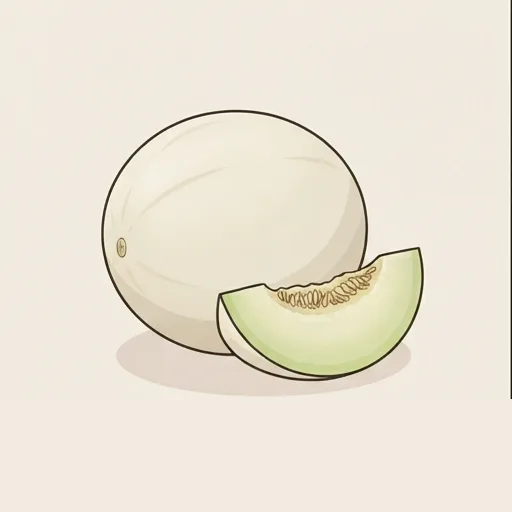
What it is
Honeydew melon is a Cucumis melo variety with smooth pale rind and pale green flesh.
What it tastes like
On the nose: pears, sulfurous, pineapple, citrus. Among its measured molecules: but-2-enal, 2-ethylfuran, propyl acetate, 1-penten-3-one, butanal.
What goes with it
- Onionboth carry propyl acetate, pearscite
- Oliveboth carry methyl acetatecite
- Apricotboth carry butyl acetatecite
Salt and acid
Salt
Sodium 18 mg per 100 g — USDA FoodData Central 169911.
Acid
Acid not measured yet.
Unusual pairings
Pairs the library can cite that almost nobody makes.
- Honeydew melon + Grapefruit
both carry decanal, citrus (57 of 338 carry it)
- Honeydew melon + Kiwifruit
both carry ethyl butyrate, pineapple (29 of 338 carry it)
- Honeydew melon + Sauerkraut
both carry dimethyl disulfide, sulfurous (17 of 338 carry it)
15 of 151 compounds on file carry a paper the library can cite.
acetaldehydearomaaldehydereads as pungent, fruity odor (PubChem)Measured in 18 of 338 ingredients.cite
0.25% of the total identified volatiles in 'Piel de Sapo' — Dos-Santos et al. 2023, Foods (Table 2, order 40, CAS 000075-07-0, class ALD, column 'PS')benzaldehydearomaaldehydereads as burning aromatic taste (PubChem)Measured in 54 of 338 ingredients.cite
0.39% of the total identified volatiles in 'Piel de Sapo' — Dos-Santos et al. 2023, Foods (Table 2, order 75, CAS 000100-52-7, class ALD, column 'PS')butanalaromaaldehydereads as characteristic, pungent, aldehyde odor (PubChem)Measured in 7 of 338 ingredients.cite
0.35% of the total identified volatiles in 'Piel de Sapo' — Dos-Santos et al. 2023, Foods (Table 2, order 46, CAS 000123-72-8, class ALD, column 'PS')ethanolaromaalcoholreads as burning (PubChem)Measured in 19 of 338 ingredients.cite
0.43% of the total identified volatiles in 'Piel de Sapo', significantly above the 0.12% of NIL SC3-5-7 — Dos-Santos et al. 2023, Foods (Table 2, order 42, CAS 00064-17-5, class ALC, column 'PS')methanethiolaromasulfur compoundMeasured in 10 of 338 ingredients.cite
0.35% of the total identified volatiles in 'Piel de Sapo' — one of only two sulfur compounds present in the non-aromatic parent at all, and it goes DOWN rather than up in the climacteric lines — Dos-Santos et al. 2023, Foods (Table 2, order 41, CAS 000074-93-1, class SDC (sulfur-derived), column 'PS')hexanalaromaaldehydereads as sharp, aldehyde odor (PubChem)Measured in 85 of 338 ingredients.cite
19.68% of the total identified volatiles in 'Piel de Sapo' — more than twenty-eight times the next melon volatile in the same column, and higher than in any of the five climacteric near-isogenic lines except the non-climacteric SC3-5-7 (19.64%) — Dos-Santos et al. 2023, Foods (Table 2 (Main fruit volatile compounds identified for QTL mapping in melon chromosome 3 ... and the parental control 'Piel de Sapo' (PS), n = 21), order 64, CAS 000066-25-1, class ALD, column 'PS')methyl acetatearomaesterreads as pleasant odor (PubChem)Measured in 9 of 338 ingredients.cite
0.69% of the total identified volatiles in 'Piel de Sapo'; the introgression lines carry up to 2.25% — Dos-Santos et al. 2023, Foods (Table 2, order 33, CAS 000079-20-9, class ACE, column 'PS')ethyl butyratearomaesterreads as pineapple odor (PubChem)Measured in 21 of 338 ingredients.cite
0.18% of the total identified volatiles in 'Piel de Sapo' — one of the very few esters the non-climacteric parent makes at all, against 0.82% in the non-climacteric NIL and 0.54% in a climacteric one — Dos-Santos et al. 2023, Foods (Table 2, order 9, CAS 000105-54-4, class NAE (non-acetate ester), column 'PS')propyl acetatearomaesterreads as odor of pears (PubChem)Measured in 5 of 338 ingredients.cite
0.16% of the total identified volatiles in 'Piel de Sapo' — the fifteenth and last of the ranking, one hundredth of a percentage point above (Z)-non-3-en-1-ol at 0.15% — Dos-Santos et al. 2023, Foods (Table 2, order 4, CAS 000109-60-4, class ACE, column 'PS')decanalaromaaldehydereads as citrus odor (PubChem)Measured in 36 of 338 ingredients.cite
0.49% of the total identified volatiles in 'Piel de Sapo' — significantly higher than in the non-climacteric NIL SC3-5-7 (0.13%) — Dos-Santos et al. 2023, Foods (Table 2, order 101, CAS 000112-31-2, class ALD, column 'PS')dimethyl disulfidearomasulfur compoundreads as sulfurous (PubChem)Measured in 9 of 338 ingredients.cite
0.33% of the total identified volatiles in 'Piel de Sapo', reported under its systematic name — Dos-Santos et al. 2023, Foods (Table 2, order 58, CAS 068920-64-9, class SDC, column 'PS')1-penten-3-onearomaketoneMeasured in 5 of 338 ingredients.cite
0.38% of the total identified volatiles in 'Piel de Sapo', roughly double the level in two of the climacteric lines — Dos-Santos et al. 2023, Foods (Table 2, order 54, CAS 017528-72-2, class KET, column 'PS')2-ethylfuranaromafuranMeasured in 4 of 338 ingredients.cite
0.50% of the total identified volatiles in 'Piel de Sapo' — Dos-Santos et al. 2023, Foods (Table 2, order 56, CAS 003208-16-0, column 'PS')but-2-enalaromaaldehydeMeasured in 1 of 338 ingredients.cite
0.25% of the total identified volatiles in 'Piel de Sapo', significantly higher than in two of the climacteric lines — Dos-Santos et al. 2023, Foods (Table 2, order 49, CAS 000123-73-9, class ALD, column 'PS')butyl acetatearomaesterreads as sweet (PubChem)Measured in 8 of 338 ingredients.cite
0.17% of the total identified volatiles in 'Piel de Sapo', against 2.31% and 1.99% in the two most strongly climacteric lines — a thirteen-fold ester gap created by one introgression — Dos-Santos et al. 2023, Foods (Table 2, order 11, CAS 000123-86-4, class ACE, column 'PS')
On file, no cited source yet ✳
These molecules are on record for it from the library's earlier sources. We are buying and requesting the papers; each one that lands moves its molecule up into the cited list.
- (3R,4aR,6aS,6bS,8aS,11R,12aR,14bS)-11-(hydroxymethyl)-4,4,6a,6b,8a,11,14b-heptamethyl-1,2,3,4a,7,8,9,10,12,12a,13,14-dodecahydropicen-3-olterpenoid
- 5-Dehydrokarounidiolterpenoid
- (+)-tirucallolterpenoid
- Arvenin IIterpenoid
- (13Z)-β-caroteneterpenoid
- margaric acidacid
- arachidic acidacid
- myristic acidacid
- heptadec-2-enoic acidacid
- isomultiflorenolalcohol
- matairesinolphenol
- 5-Hydroxy-11-methyl-6-methylidene-16-oxo-15-oxapentacyclo[9.3.2.15,8.01,10.02,8]heptadec-12-ene-9-carboxylic acidterpenoid
- multiflorenolterpenoid
- tridecanoic acidacid
- 24-Ethyl-5alpha-cholest-7-en-3beta-olterpenoid
- (2S,8S,9R,10R,13R,14S,16R,17R)-2,16-dihydroxy-4,4,9,13,14-pentamethyl-17-[(2R,5R)-2,5,6-trihydroxy-6-methyl-3-oxoheptan-2-yl]-2,7,8,10,12,15,16,17-octahydro-1H-cyclopenta[a]phenanthrene-3,11-dioneterpenoid
- palmitic acidacidreads as slight characteristic taste (PubChem)
- Codisterolterpenoid
- pentadecanoic acidacid
- stearic acidacidreads as taste suggesting tallow (PubChem)
- 23,24-dihydroisocucurbitacin Bterpenoid
- 2EC,3EC,4aI<<-Trihydroxy-1EC-methyl-8-methylenegibbane-1I<<,10EC-dicarboxylic acid 1,4a-lactoneterpenoid
- 1,3,3-trimethyl-2-[(1E,3E,5E,7E,9E)-3,7,12,16-tetramethyl-18-(2,6,6-trimethylcyclohexen-1-yl)octadeca-1,3,5,7,9,11,13,15,17-nonaenyl]cyclohexeneterpenoid
- (2S,8R,9R,10R,13S,14R,16S,17S)-2,16-dihydroxy-4,4,9,13,14-pentamethyl-17-[(2S,5S)-2,5,6-trihydroxy-6-methyl-3-oxoheptan-2-yl]-2,7,8,10,12,15,16,17-octahydro-1H-cyclopenta[a]phenanthrene-3,11-dioneterpenoid
- Bryonololterpenoid
- [(E,6R)-6-[(2S,8S,9R,10S,13R,14S,16R,17R)-2,16-dihydroxy-4,4,9,13,14-pentamethyl-3,11-dioxo-2,7,8,10,12,15,16,17-octahydro-1H-cyclopenta[a]phenanthren-17-yl]-6-hydroxy-2-methyl-5-oxohept-3-en-2-yl] acetateterpenoid
- Karounidiolterpenoid
- bryonolic acidacid
- (2S,8S,9R,10R,13R,14S,16R,17R)-2,16-dihydroxy-4,4,9,13,14-pentamethyl-17-[(E,2S,4R)-2,4,7-trihydroxy-6-methylhept-5-en-2-yl]-2,7,8,10,12,15,16,17-octahydro-1H-cyclopenta[a]phenanthrene-3,11-dioneterpenoid
- (3S,4aS,6aR,6bS,8aR,12aR,14aR,14bS)-6a,6b,8a,11,11,14b-hexamethyl-2,3,4,4a,5,6,7,8,9,10,12,12a,14,14a-tetradecahydro-1H-picen-3-olterpenoid
- JUQMDBKTOSZQSN-ZUQOZQHBSA-Nterpenoid
- (8R,9S,10S,13R,14S,17R)-4,4,13,14-tetramethyl-17-[(2R)-6-methylhept-5-en-2-yl]-2,3,7,8,9,10,12,15,16,17-decahydro-1H-cyclopenta[a]phenanthren-11-oneterpenoid
- (3S,4aS,6aR,6bS,8aR,11R,12S,12aR,14aR,14bS)-6a,6b,8a,11,12,14b-hexamethyl-1,2,3,4,4a,5,6,7,8,9,10,11,12,12a,14,14a-hexadecahydropicen-3-olterpenoid
- PAIYWJACOOPBDM-QYKIRDNDSA-Nterpenoid
- 4-[(9E,11E,13E,15E,17E)-18-(4-hydroxy-2,6,6-trimethylcyclohex-1-en-1-yl)-3,7,12,16-tetramethyloctadeca-1,3,5,7,9,11,13,15,17-nonaen-1-yl]-3,5,5-trimethylcyclohex-2-en-1-olterpenoid
- non-2-enalaldehyde
- 23,24-dihydrocucurbitacin Dketone
- arvenin IIIterpenoid
- Lorantholterpenoid
- ethyl 2-methylbutyrateester
- dihydrocucurbitacin bketone
- β-iononeterpenoidreads as warm woody, dry, and fruity odor (PubChem)
- (+/-)-dihydroactinidiolidefuran
- benzyl propionateester
- 3-phenylpropyl acetateester
- Glucoisovitexinflavonoid
- 5,12,13-Trihydroxy-11-methyl-6-methylidene-16-oxo-15-oxapentacyclo[9.3.2.15,8.01,10.02,8]heptadecane-9-carboxylic acidterpenoid
- lariciresinolalcohol
- [17-(5-ethyl-6-methylhept-3-en-2-yl)-10,13-dimethyl-2,3,4,5,6,9,11,12,14,15,16,17-dodecahydro-1H-cyclopenta[a]phenanthren-3-yl] acetateterpenoid
- lauric acidacidreads as characteristic, like oil of bay (PubChem)
- octadeca-9,12-dienoic acidacid
- 3,6-Nonadien-1-olalcohol
- (1S,2S,4R,6S,8S,9R,10R,13S,14R,16S,17R,21S)-8,16,17,21-tetrahydroxy-6-[(E)-3-hydroxy-2-methylprop-1-enyl]-2,8,10,13,18,18-hexamethyl-5-oxapentacyclo[11.8.0.02,10.04,9.014,19]henicos-19-en-12-oneterpenoid
- BTKXYYIQKCDSPF-XNCXWTMSSA-Nterpenoid
- (2S,8S,9R,10R,13R,14S,16R,17R)-17-[(2R)-2,6-dihydroxy-6-methyl-3-oxoheptan-2-yl]-2,16-dihydroxy-9-(hydroxymethyl)-4,4,13,14-tetramethyl-2,7,8,10,12,15,16,17-octahydro-1H-cyclopenta[a]phenanthrene-3,11-dioneterpenoid
- 23,24-dihydro-7beta-hydroxycucurbitacin Bterpenoid
- AFXPJFXBBQEMAB-VPBSPBINSA-Nterpenoid
- 25-deacetylcucurbitacin Aterpenoid
- 7beta-hydroxycucurbitacin Bterpenoid
- (2S,8S,9R,10R,13R,14S,16R,17R)-17-acetyl-16-hydroxy-4,4,9,13,14-pentamethyl-2-[(2S,3R,4S,5S,6R)-3,4,5-trihydroxy-6-(hydroxymethyl)oxan-2-yl]oxy-2,7,8,10,12,15,16,17-octahydro-1H-cyclopenta[a]phenanthrene-3,11-dioneterpenoid
- eupholterpenoid
- oleic acidacidreads as peculiar lard-like odor (PubChem)
- isovitexinflavonoid
- 24-Dien-11-oneterpenoid
- hexanorcucurbitacin Dterpenoid
- 5-Hydroxy-11-methyl-6-methylidene-16-oxo-15-oxapentacyclo[9.3.2.15,8.01,10.02,8]heptadecane-9-carboxylic acidterpenoid
- Bryonolic acidterpenoid
- quercetinflavonoid
- Gibberellin A1terpenoid
- apigeninflavonoid
- luteolinflavonoid
- linoleic acidacid
- gibberellin A20terpenoid
- β-caroteneterpenoid
- gibberellin A8terpenoid
- (all-E)-phytoeneterpenoid
- all-trans-zeta-caroteneterpenoid
- stigmasterolalcohol
- kaempferolflavonoid
- alpha-linolenic acidacid
- cryptoxanthinterpenoid
- cucurbitacin aterpenoid
- cucurbitacin bketone
- isofucosterolalcohol
- α-spinasterinterpenoid
- myricetinflavonoid
- gibberellin A34terpenoid
- gibberellin A5terpenoid
- Cinnamyl acetateester
- elaidolinolenic acidacid
- 24-epicampesterolalcohol
- Clerosterolterpenoid
- 1,3,3-trimethyl-2-[(1E,3Z,5Z,7E,9E,11E,13Z,15Z,17E)-3,7,12,16-tetramethyl-18-(2,6,6-trimethylcyclohexen-1-yl)octadeca-1,3,5,7,9,11,13,15,17-nonaenyl]cyclohexeneterpenoid
- (6Z)-6-nonenyl acetateester
- pentadec-2-enoic acidacid
- (24R)-24-methylcycloart-25-en-3beta-olalcohol
- trigonellinenitrogen compound
- adenosinenitrogen compoundreads as mild, saline, or bitter taste (PubChem)
- ethyl 3-(methylthio)propanoatesulfur compound
- Gibbane-1,10-dicarboxylic acid, 2,4a-dihydroxy-1-methyl-8-methylene-, 1,4a-lactone, (1alpha,2beta,4aalpha,4bbeta,10beta)-terpenoid
- Stigmast-7-en-3-ol, acetate, (3beta,5alpha)-terpenoid
- trans-β-iononeterpenoidreads as warm woody, dry, and fruity odor (PubChem)
- alpha carotene (stereochemistry specified)terpenoid
- (3Z,6Z)-3,6-nonadien-1-olalcohol
- all-trans-phytoflueneterpenoid
- Arvenin Iterpenoid
- Gibberellic acidterpenoid
- secoisolariciresinol
- Tetrahydroisocucurbitacin Iterpenoid
- (15Z)-phytoflueneterpenoid
- (3S,4aR,6aR,6aS,8aR,12aS,14aR,14bR)-4,4,6a,6a,8a,11,11,14b-octamethyl-1,2,3,4a,5,6,8,9,10,12,12a,13,14,14a-tetradecahydropicen-3-olterpenoid
- echinocystic acidterpenoid
- (+)-pinoresinolphenol
- Cinnamyl acetateacid
- ethyl (methylthio)acetateester
- ethyl decanoateester
- 1-hexanolalcoholreads as fatty, fruity (PubChem)
- heptyl acetateester
- octyl acetateester
- behenic acidacid
- octadeca-9,12,15-trienoic acidacid
- benzyl acetateesterreads as pear-like odor (PubChem)
- ethyl acetateesterreads as fragrant odor (PubChem)
- hexyl acetateesterreads as sweet ester odor (PubChem)
- 1-nonanolalcoholreads as floral odor (PubChem)
- nonyl acetateester
- 3',5-Dihydroxy-4'-methoxy-7-(beta-D-glucurono pyranosyloxy)flavone methyl esterflavonoid
- gibberellin A4terpenoid
- cycloartenolalcohol
- 24-methylenecholesterolalcohol
- lupenoneterpenoid
- 24-Methylenecycloartanolalcohol
- octadec-9-enoic acidacid
- (9Z)-β-caroteneterpenoid
- β-cyclocitralterpenoid
- 15-cis-phytoeneterpenoid
Sources
- Dos-Santos et al. 2023, Foods