Hojicha
Sweet & rich· tea coffee cacao
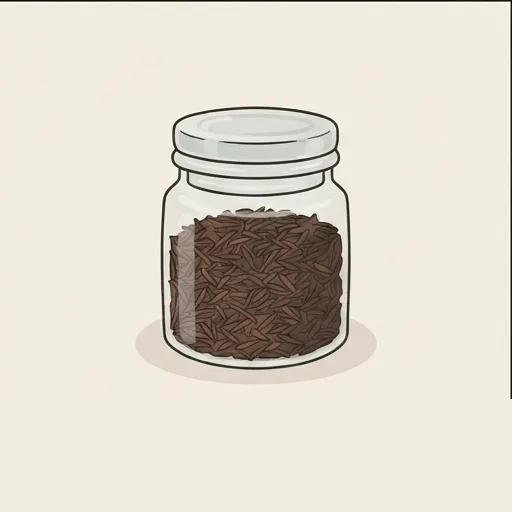
What it is
Hojicha is Japanese green tea that has been roasted over charcoal or in a pan after processing, turning the leaves reddish-brown.
What it tastes like
On the nose: bitter, woody, rose; the house adds roasted ✳. Among its measured molecules: 2-ethylpyrazine, 2-acetylpyrazine, ligustrazine, 2,3-diethyl-5-methylpyrazine, 2-ethyl-5-methylpyrazine.
What goes with it
- Oolong teaboth carry 2,3-diethyl-5-methylpyrazine, earthycite
- Coffeeboth carry 2-ethyl-3,5-dimethylpyrazine, almondcite
- Chicory rootboth carry 2-ethyl-5-methylpyrazine, coffeecite
Salt and acid
Salt
Salt not measured yet.
Acid
Acid not measured yet.
Unusual pairings
Pairs the library can cite that almost nobody makes.
- Hojicha + Coffee
both carry 2-ethyl-5-methylpyrazine, coffee (9 of 338 carry it)
- Hojicha + Chicory root
both carry 2-ethyl-5-methylpyrazine, coffee (9 of 338 carry it)
- Hojicha + Cape gooseberry
both carry 2,3-diethyl-5-methylpyrazine, earthy (3 of 338 carry it)
Every one of its 15 compounds carries a paper the library can cite.
caffeinetastenitrogen compoundreads as bitter taste (PubChem)Measured in 1 of 338 ingredients.cite
13.0 mg/100 g in the roasted green tea beverage against 14.0 mg/100 g in the green tea beverage — a second commercial product, same conclusion — Kurosaka et al. 2024, Scientific Reports (Supplementary Table 1, row 'Caffeine anhydrous' (per 100 g))ligustrazinearomapyrazineMeasured in 3 of 338 ingredients.cite
1.2 µg/L in the roasted green tea (hojicha) beverage, while in both the green tea and the water it is below the stated 0.5 µg quantitation limit — quantifiable only in the hojicha — Kurosaka et al. 2024, Scientific Reports (Supplementary Table 1, row 'Tetramethylpyrazine' (per 1 L))2-ethyl-5-methylpyrazinearomapyrazineMeasured in 4 of 338 ingredients.cite
1.20% in the commercial Bancha Hojicha against 1.01% in the unroasted Bancha; odour quality 'Roasty, sweet'. Rises to 1.74% in the same Bancha roasted at 180 °C, so the roast direction is confirmed within the paper even though the commercial sample's margin over the raw leaf is small. — Roberto Gotti et al. 2021, Applied Sciences (Table 2, row 6, RI 1007)3-ethyl-2,5-dimethylpyrazinearomapyrazineMeasured in 6 of 338 ingredients.cite
3.55% relative content in the commercial Bancha Hojicha against 0.00% in the unroasted Bancha it is made from — created outright by the roast; odour quality given as 'Roasty, sweet'. The Results state: 'In the analyzed green teas, except for Hojicha, 2-ethyl-3,6-dimethylpirazine was absent, hence, its formation and concentration trend after roasting can be used as useful markers of the process.' — Roberto Gotti et al. 2021, Applied Sciences (Table 2 (Linear retention index (RI), odor quality and relative percentage of key odorants in representative green teas: Bancha, Bancha Hojicha and roasted Bancha green tea (180 °C)), row 7, RI 1052)2-ethylpyrazinearomapyrazineMeasured in 1 of 338 ingredients.cite
0.03% in the commercial Bancha Hojicha against 0.00% in the unroasted Bancha — absent before the roast, present after; rises further to 0.05% in the same Bancha roasted at 180 °C. Odour quality 'Roasty, sweet'. — Roberto Gotti et al. 2021, Applied Sciences (Table 2, row 3, RI 916)2-ethyl-6-methylpyrazinearomapyrazineMeasured in 5 of 338 ingredients.cite
1.10% in the commercial Bancha Hojicha against 0.61% in the unroasted Bancha — a 1.8-fold increase; odour quality 'Roasty, sweet'. Quantified in µg/mL against an isotopically labelled internal standard in the paper's validated SIM method (Figure 3), where all identified pyrazines rose from 160 °C to 200 °C. — Roberto Gotti et al. 2021, Applied Sciences (Table 2, row 5, RI 1005)2-ethyl-3,5-dimethylpyrazinearomapyrazineMeasured in 6 of 338 ingredients.cite
1.52% in the commercial Bancha Hojicha against 0.62% in the unroasted Bancha — a 2.5-fold increase; odour quality 'Roasty, sweet' — Roberto Gotti et al. 2021, Applied Sciences (Table 2, row 8, RI 1055)2,3-diethyl-5-methylpyrazinearomapyrazineMeasured in 3 of 338 ingredients.cite
1.2 µg/L in the roasted green tea (hojicha) beverage, while in both the green tea and the water it is below the stated 1.0 µg quantitation limit. The table's own footnote records the interference correction: 'In green tea and roasted green tea, the 2,3-diethyl-5-methylpyrazine peak overlapped with other peaks (isomers and presumed isomers). The overlapping peaks were subtracted from the quantification.' — Kurosaka et al. 2024, Scientific Reports (Supplementary Table 1, row '2,3-Diethyl-5-methylpyrazine' (per 1 L))2-acetylpyrazinearomapyrazineMeasured in 1 of 338 ingredients.cite
3.52% in the commercial Bancha Hojicha against 0.85% in the unroasted Bancha — a 4.1-fold increase, the largest ratio of any compound in the table that is present in both; odour quality 'Nutty'. It is one of the five pyrazines the paper selected for absolute µg/mL quantitation, on the stated grounds that they 'have been considered among the most important odorants giving the desirable Hojicha flavor' — a rationale the paper attributes to its own references [7,8], so it is recorded here as the paper's selection criterion and NOT as a measured claim; the measured claim is the 3.52% figure. — Roberto Gotti et al. 2021, Applied Sciences (Table 2, row 12, RI 1101)epigallocatechin gallatetasteesterMeasured in 1 of 338 ingredients.cite
3.2 mg/100 g in the roasted green tea beverage against 10 mg/100 g in the green tea beverage — Kurosaka et al. 2024, Scientific Reports (Supplementary Table 1, row 'Epigallocatechin gallate' (per 100 g))gallocatechintasteflavonoidMeasured in 1 of 338 ingredients.cite
2.73 mg/100 mg of gallocatechin in roasted green tea extract; the same row's total catechin content is 13.27 mg/100 mg against 34.62 for the unroasted extract, which the Results describe as a decrease 'by about 1/3 during the roasting process' — Goto et al. 2023, Foods (Table 1 (Contents of catechins (mg/100 mg) and tannins), row 'REx' (roasted green tea extract), column 'GC')theaninetasteacidreads as slightly sweet (PubChem)Measured in 1 of 338 ingredients.cite
not detected in the roasted green tea beverage while the green tea beverage carried 3.0 mg/100 g. The cell is rendered 'Not deleted' in the supplementary file — a typographical slip for 'Not detected', read that way because the water column carries the same cell. — Kurosaka et al. 2024, Scientific Reports (Supplementary Table 1, row 'Theanine' (per 100 g, determination limit 1.0 mg))geraniolaromaalcoholreads as sweet rose odor (PubChem)Measured in 26 of 338 ingredients.cite
10.03% in the commercial Bancha Hojicha against 4.70% in the unroasted Bancha — a 2.1-fold increase and the single largest relative percentage in the hojicha column; rises again to 14.65% at a 180 °C lab roast. Odour quality 'Floral, sweet'. Not a roast product: a green-tea terpenoid the roast concentrates, which is why it is ranked below the pyrazines despite being the biggest peak. — Roberto Gotti et al. 2021, Applied Sciences (Table 2, RI 1256)trans-β-iononearomaterpenoidreads as warm woody, dry, and fruity odor (PubChem)Measured in 19 of 338 ingredients.cite
2.73% in the commercial Bancha Hojicha against 5.07% in the unroasted Bancha — nearly halved by the roast, and down again to 2.12% at 180 °C. Odour quality 'Woody, floral, violet-like'. Included as a measured LOSS: the Results state that 'β-damascenone and β-ionone content decreased' with roasting temperature across the tested teas. — Roberto Gotti et al. 2021, Applied Sciences (Table 2, row 17, RI 1431)2,4-heptadienalaromaaldehydeMeasured in 10 of 338 ingredients.cite
0.98% in the commercial Bancha Hojicha against 0.26% in the unroasted Bancha — a 3.8-fold increase; odour quality 'Fatty'. One of the ten odorants the paper quantified absolutely in µg/mL against isotopically labelled internal standards; the Results state its content 'increased after roasting from 160 to 200 °C for almost all the tested teas'. — Roberto Gotti et al. 2021, Applied Sciences (Table 2, row 10, RI 1088)
Sources
- Kurosaka et al. 2024, Scientific Reports
- Roberto Gotti et al. 2021, Applied Sciences
- Goto et al. 2023, Foods