Flavor← the wheel
Blood orange
Citrus· citrus
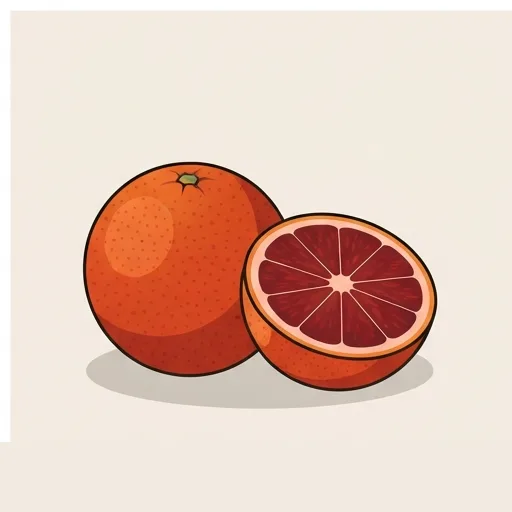
What it is
Blood orange is a Citrus sinensis variety whose flesh turns deep red from pigments that develop in cool growing conditions.
What it tastes like
On the nose: lemon-citronella-rose, citrus, spicy. Among its measured molecules: beta-thujene, eremophilene, beta-fenchol, α-Cadinene, Citronellal.
What goes with it
- Makrut limeboth carry Citronellal, intense lemon-citronella-rosecite
- Pomeloboth carry Citronellal, intense lemon-citronella-rosecite
- Juniper berryboth carry terpinolenecite
Salt and acid
Salt
Salt not measured yet.
Acid
0 %Apple2 %Cranberry4 %Apple cider vinegar6 %Balsamic vinegar8 %Makrut lime
Acid 1.338 % (g/100 mL) — the library's own composition sheet.
Unusual pairings
Pairs the library can cite that almost nobody makes.
- Blood orange + Sweet orange
both carry decanal, citrus (57 of 338 carry it)
- Blood orange + Aromatic bitters
both carry limonene, lemon (126 of 338 carry it)
- Blood orange + Sparkling wine
both carry decanal, citrus (57 of 338 carry it)
Every one of its 15 compounds carries a paper the library can cite.
linaloolaromaalcoholreads as spicy, citrus taste (PubChem)Measured in 91 of 338 ingredients.cite
5.52% of blood orange peel oil, against 1.09% (Washington Navel), 6.29% (Balady Seeded Orange) and 1.04% (Sweet Orange Sukkari) measured the same way in the same table — Elmaidomy et al. 2026, Scientific Reports (Table 2, row 'Linalool' (compound 15), 'Blood orange' column)alpha-pinenearomaterpenoidreads as odor of turpentine (PubChem)Measured in 71 of 338 ingredients.cite
4.89% of blood orange peel oil; the paper names α-pinene among the constituents showing significant variation between the four Citrus sinensis varieties — Elmaidomy et al. 2026, Scientific Reports (Table 2, row 'α-Pinene' (compound 4), 'Blood orange' column)Citronellalaromaterpenoidreads as intense lemon-citronella-rose odor (PubChem)Measured in 8 of 338 ingredients.cite
0.36% of blood orange peel oil; counted by the paper among the oxygenated acyclic compounds — Elmaidomy et al. 2026, Scientific Reports (Table 2, row '(R)-(+)-Citronellal' (compound 16), 'Blood orange' column)decanalaromaaldehydereads as citrus odor (PubChem)Measured in 36 of 338 ingredients.cite
0.95% of blood orange peel oil — Elmaidomy et al. 2026, Scientific Reports (Table 2, row 'Decanal' (compound 19), 'Blood orange' column)terpinolenearomaterpenoidreads as terpene taste (PubChem)Measured in 38 of 338 ingredients.cite
0.76% of blood orange peel oil; the paper groups it with D-limonene as part of the principal cyclic-hydrocarbon fraction — Elmaidomy et al. 2026, Scientific Reports (Table 2, row 'p-Mentha-1,4(8)-diene' (compound 12), 'Blood orange' column)sabinenearomaterpenoidMeasured in 32 of 338 ingredients.cite
2.42% of blood orange peel oil; listed by the paper among the bicyclic hydrocarbons that vary significantly across the four varieties — Elmaidomy et al. 2026, Scientific Reports (Table 2, row '(+)-Sabinene' (compound 5), 'Blood orange' column)limonenearomaterpenoidreads as pleasant lemon-like (PubChem)Measured in 91 of 338 ingredients.cite
63.51% of blood orange peel oil; the same row gives 67.55% for Washington Navel, 61.95% for Balady Seeded Orange and 91.23% for Sweet Orange Sukkari — Elmaidomy et al. 2026, Scientific Reports (Table 2 (Citrus sinensis varieties peel oils composition using GC/MS analysis), row 'D-Limonene' (compound 8), 'Blood orange' column — the third of the four %Area columns)3-carenearomaterpenoidMeasured in 19 of 338 ingredients.cite
3.76% of blood orange peel oil — the highest of the four Citrus sinensis varieties in the table (2.00% Washington Navel, 1.11% Balady Seeded Orange, not detected in Sweet Orange Sukkari) — Elmaidomy et al. 2026, Scientific Reports (Table 2, row '3-Carene' (compound 9), 'Blood orange' column)myrcenearomaterpenoidreads as pleasant (PubChem)Measured in 68 of 338 ingredients.cite
14.29% of blood orange peel oil — the second-largest constituent; 13.72% for Washington Navel, 14.82% for Balady Seeded Orange, 4.59% for Sweet Orange Sukkari — Elmaidomy et al. 2026, Scientific Reports (Table 2, row 'α-Myrcene' (compound 6), 'Blood orange' column)beta-thujenearomaterpenoidMeasured in 1 of 338 ingredients.cite
0.53% of blood orange peel oil; one of the compounds the paper reports as varying significantly across the four Citrus sinensis varieties — Elmaidomy et al. 2026, Scientific Reports (Table 2, row '2-Thujene' (compound 3), 'Blood orange' column)geranialaromaterpenoidreads as strong lemon odor (PubChem)Measured in 21 of 338 ingredients.cite
1.43% of blood orange peel oil, the largest of the four varieties for this compound; counted by the paper among the oxygenated compounds — Elmaidomy et al. 2026, Scientific Reports (Table 2, row 'α-Citral' (compound 20), 'Blood orange' column)beta-fencholaromaterpenoidMeasured in 2 of 338 ingredients.cite
0.64% of blood orange peel oil; detected in only two of the four Citrus sinensis varieties (0.86% in Balady Seeded Orange, absent from Washington Navel and Sweet Orange Sukkari) — Elmaidomy et al. 2026, Scientific Reports (Table 2, row '(-)-(1 S,2R,4R)-β-Fenchol' (compound 18), 'Blood orange' column)α-CadinenearomaterpenoidMeasured in 4 of 338 ingredients.cite
0.21% of blood orange peel oil; a sesquiterpene hydrocarbon, present at almost the same level in three of the four varieties (0.22%, 0.21%, 0.21%) — Elmaidomy et al. 2026, Scientific Reports (Table 2, row 'α-Cadinene' (compound 25), 'Blood orange' column)eremophilenearomaterpenoidMeasured in 1 of 338 ingredients.cite
0.55% of blood orange peel oil; the largest of the three sesquiterpenes detected in it — Elmaidomy et al. 2026, Scientific Reports (Table 2, row 'Eremophila-1(10),11-diene' (compound 24), 'Blood orange' column)α-copaenearomaterpenoidMeasured in 18 of 338 ingredients.cite
0.18% of blood orange peel oil — the smallest constituent reported for it, and detected in none of the other three Citrus sinensis varieties in the table — Elmaidomy et al. 2026, Scientific Reports (Table 2, row 'α-Copaene' (compound 21), 'Blood orange' column)
Sources
- Elmaidomy et al. 2026, Scientific Reports