Tonka bean
Spice & roots· spice
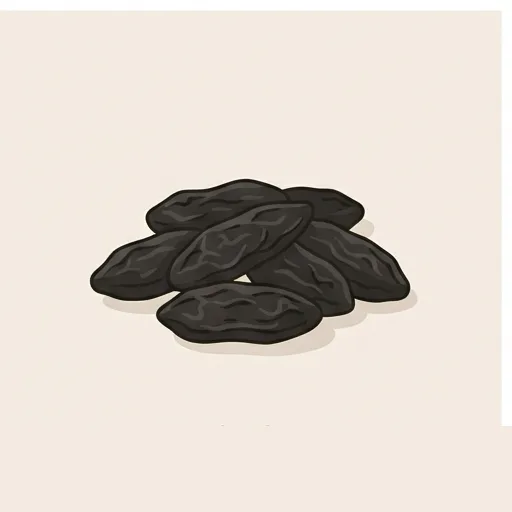
What it is
Tonka bean is the dried seed of Dipteryx odorata, a South American tree, restricted or banned as a food ingredient in some countries including the United States.
What it tastes like
On the nose: herbal, butter; the house adds tallow ✳. Among its measured molecules: dihydrocoumarin, methyl melilotate, ethyl melilotate, coumarin, 5-hydroxymethylfurfural.
What goes with it
- Balsamic vinegarboth carry 5-hydroxymethylfurfural, caramel mustycite
- Black garlicboth carry 5-hydroxymethylfurfural, caramel mustycite
- Brandyboth carry 5-hydroxymethylfurfural, caramel mustycite
Salt and acid
Salt
Salt not measured yet.
Acid
Acid not measured yet.
Unusual pairings
Pairs the library can cite that almost nobody makes.
- Tonka bean + Balsamic vinegar
both carry 5-hydroxymethylfurfural, caramel musty (19 of 338 carry it)
- Tonka bean + Black garlic
both carry 5-hydroxymethylfurfural, caramel musty (19 of 338 carry it)
- Tonka bean + Brandy
both carry 5-hydroxymethylfurfural, caramel musty (19 of 338 carry it)
8 of 46 compounds on file carry a paper the library can cite.
coumarinaromacoumarinreads as burning taste (PubChem)Measured in 2 of 338 ingredients.cite
the review records tonka beans as the first plant from which coumarin was extracted and isolated, containing 1–3% coumarin and in rare cases up to 10%, with 138 further components detected in the bean extract — its citation of an earlier study rather than its own measurement. The same review records EFSA's tolerable daily intake for coumarin as 0.1 mg per kg body weight, derived from hepatotoxicity in a two-year dog study and reconfirmed in 2008 and 2012. — Lončar et al. 2020, Foods (Section 3.1 (Natural Sources of Coumarin), the passage on tonka beans, and the Health-Based Guidance Value section)dihydrocoumarinaromareads as herbal (PubChem)Measured in 1 of 338 ingredients.cite
named as detected in tonka-bean ethanol extract in this review's account of a cited GC-MS and HPLC study — a presence record compiled from the published literature, not a measurement by the review's authors. Note that the one paper on disk that MEASURES dihydrocoumarin in a Dipteryx seed measures it in D. punctata, a different species, at 25.2%, and that value is therefore not carried here. — Lončar et al. 2020, Foods (Section on the determination of coumarins in tonka beans, listing the components detected in the ethanol extract by GC-MS and then quantified by HPLC)melilotic acidtastephenolMeasured in 1 of 338 ingredients.cite
named as detected in tonka-bean ethanol extract in this review's account of a cited GC-MS and HPLC study — a presence record compiled from the published literature, not a measurement by the review's authors — Lončar et al. 2020, Foods (Section on the determination of coumarins in tonka beans, listing the components detected in the ethanol extract)5-hydroxymethylfurfuralaromaalcoholreads as butter, caramel, musty (PubChem)Measured in 11 of 338 ingredients.cite
named as detected in tonka-bean ethanol extract in this review's account of a cited GC-MS and HPLC study — a presence record compiled from the published literature, not a measurement by the review's authors. It is a sugar-degradation product rather than a coumarin, which is worth noting because it is also the compound the repo's caramel and roasted nodes carry. — Lončar et al. 2020, Foods (Section on the determination of coumarins in tonka beans, listing the components detected in the ethanol extract)o-coumaric acidtasteacidMeasured in 1 of 338 ingredients.cite
named twice as a constituent of tonka beans in this review's account of a cited study — a presence record compiled from the published literature, not a measurement by the review's authors — Lončar et al. 2020, Foods (Section 3.1, the tonka-bean passage and the following account of the components detected in its ethanol extract)methyl melilotatearomaMeasured in 1 of 338 ingredients.cite
named as detected in tonka-bean ethanol extract in this review's account of a cited GC-MS and HPLC study — a presence record compiled from the published literature, not a measurement by the review's authors — Lončar et al. 2020, Foods (Section on the determination of coumarins in tonka beans, listing the components detected in the ethanol extract)umbelliferonetastecoumarinMeasured in 1 of 338 ingredients.cite
named, with o-coumaric acid and diterpenoids, among the constituents of tonka beans beyond coumarin in this review's account of a cited study — a presence record compiled from the published literature, not a measurement by the review's authors — Lončar et al. 2020, Foods (Section 3.1 (Natural Sources of Coumarin), the tonka-bean passage)ethyl melilotatearomaMeasured in 1 of 338 ingredients.cite
named as detected in tonka-bean ethanol extract in this review's account of a cited GC-MS and HPLC study — a presence record compiled from the published literature, not a measurement by the review's authors — Lončar et al. 2020, Foods (Section on the determination of coumarins in tonka beans, listing the components detected in the ethanol extract)
On file, no cited source yet ✳
These molecules are on record for it from the library's earlier sources. We are buying and requesting the papers; each one that lands moves its molecule up into the cited list.
- 5-MethoxyanthocercinAflavonoid
- Dipteryxic acidterpenoid
- 4-hydroxybenzoic acidacid
- palmitic acidacidreads as slight characteristic taste (PubChem)
- stearic acidacidreads as taste suggesting tallow (PubChem)
- odoratinflavonoid
- dipteryxineflavonoid
- (2R,3S)-3-(4-hydroxy-3,5-dimethoxyphenyl)-8-(3-hydroxy-4-methoxyphenyl)-2-(hydroxymethyl)-5-methoxy-2,3-dihydropyrano[3,2-h][1,4]benzodioxin-7-oneflavonoid
- (4S,4aS,6aR,7S,10aS,11aR,11bS)-10a-hydroxy-4,7,11b-trimethyl-9-oxo-1,2,3,4a,5,6,6a,7,11,11a-decahydronaphtho[2,1-f][1]benzofuran-4-carboxylic acidterpenoid
- (2Z)-6-hydroxy-2-[(4-hydroxy-3-methoxyphenyl)methylidene]-1-benzofuran-3-oneflavonoid
- odoratineflavonoid
- Balanophonin
- (-)-lariciresinolphenol
- lupeolalcohol
- salicylic acidacid
- 4-hydroxybenzoic acidphenol
- GU17;ISL;Isoliquiritigenflavonoid
- eriodictyolflavonoid
- 3'-hydroxy-8-O-methylretusinflavonoid
- dipteryxinflavonoid
- oleic acidacidreads as peculiar lard-like odor (PubChem)
- ferulic acidacid
- 2,4-dihydroxy-trans-cinnamic acidacid
- linoleic acidacid
- sulfuretinfuran
- afrormosinflavonoid
- (8aS)-7,8-dihydroxy-5,8a-dimethyl-1-methylidene-4,5,5a,6,7,8,9,9a-octahydro-3aH-azuleno[6,5-b]furan-2-oneterpenoid
- sulfuretinflavonoid
- retusinflavonoid
- Coumaran-6-ol-3-one, 2-[4-hydroxy-3-methoxybenzylidene]-flavonoid
- 7-Hydroxy-4-benzopyrone
- (2R)-2-(3,4-dihydroxyphenyl)-6,8-dihydroxy-2,3-dihydrochromen-4-oneflavonoid
- 6-Hydroxy-2-(4'-hydroxy-3'-methoxybenzylidene)benzofuran-3(2h)-onefuran
- isoliquiritigeninflavonoid
- sulfuretinflavonoid
- betulinterpenoid
- Vouacapenic acidterpenoid
- butinflavonoid
Sources
- Lončar et al. 2020, Foods