Sauerkraut
Savory & ferment· ferment vinegar
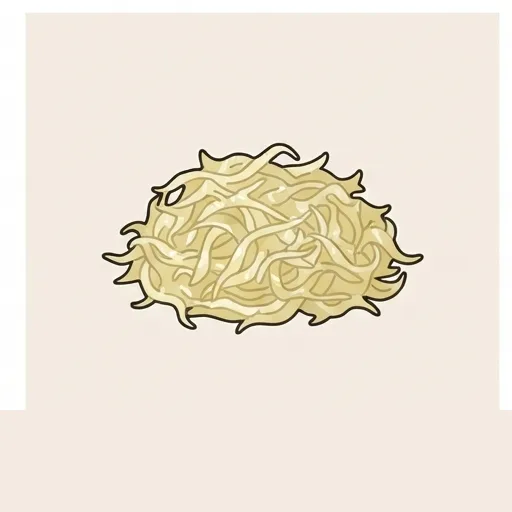
What it is
Sauerkraut is finely shredded cabbage preserved by lacto-fermentation, in which naturally occurring bacteria convert its sugars into acids.
What it tastes like
On the nose: banana, mustard, fruity, sulfurous. Among its measured molecules: nonyl acetate, (3E)-3-hexenyl acetate, ethyl palmitate, allyl isothiocyanate, pentyl acetate.
What goes with it
- Asian pearboth carry pentyl acetate, persistent bananacite
- Cantaloupeboth carry dimethyl disulfide, sulfurouscite
- Fermented strawberry juiceboth carry hexyl acetatecite
Salt and acid
Salt
Sodium 661 mg per 100 g — USDA FoodData Central 169279.
Acid
Acid not measured yet.
Unusual pairings
Pairs the library can cite that almost nobody makes.
- Sauerkraut + Asian pear
both carry pentyl acetate, persistent banana (4 of 338 carry it)
- Sauerkraut + Cantaloupe
both carry dimethyl disulfide, sulfurous (17 of 338 carry it)
- Sauerkraut + Honeydew melon
both carry dimethyl disulfide, sulfurous (17 of 338 carry it)
Every one of its 15 compounds carries a paper the library can cite.
allyl isothiocyanatearomasulfur compoundreads as mustard odor (PubChem)Measured in 3 of 338 ingredients.cite
100,499 ± 580 in 'Brgujski' and 87,984 ± 45,420 in 'Žminjski', against 27,750 in CS-1; the glucosinolate hydrolysis product, and the compound in this profile that could only have come from a brassica — Major et al. 2022, Foods (Table 2, Organosulfur compounds, row 'allyl isothiocyanate')1-pentanolaromaalcoholreads as mild odor (PubChem)Measured in 18 of 338 ingredients.cite
2,152,915 ± 264,400 in 'Brgujski', the largest alcohol of the five samples, against 321,111 in 'Žminjski' and 40,570 in CS-3. NOTE: this cell is byte-identical to the dimethyl disulfide cell for the same sample; see this profile's notes — Major et al. 2022, Foods (Table 2, Alcohols, row '1-pentanol')phenethyl acetatearomaesterMeasured in 13 of 338 ingredients.cite
7,123,750 ± 563,048 in 'Brgujski' and 4,615,988 ± 592,564 in 'Žminjski', against 171,843 / 22,569 / 290,101 in the three commercial samples — Major et al. 2022, Foods (Table 2, Esters, row '2-phenylethyl acetate')1-hexanolaromaalcoholreads as fatty, fruity (PubChem)Measured in 48 of 338 ingredients.cite
122,337 ± 17,402 in 'Brgujski' and 162,648 ± 42,423 in 'Žminjski'; highest in CS-2 at 345,102 ± 25,981 — Major et al. 2022, Foods (Table 2, Alcohols, row '1-hexanol')ethyl acetatearomaesterreads as fragrant odor (PubChem)Measured in 42 of 338 ingredients.cite
1,395,228 ± 295,733 in 'Brgujski' and 1,078,893 ± 113,810 in 'Žminjski'; the one ester where a commercial sample leads, CS-3 at 1,479,426 ± 235,640 — and where another is nearly absent, CS-2 at 45,486 — Major et al. 2022, Foods (Table 2, Esters, row 'ethyl acetate')hexyl acetatearomaesterreads as sweet ester odor (PubChem)Measured in 17 of 338 ingredients.cite
424,619 ± 64,423 in 'Brgujski' and 2,256,204 ± 218,496 in 'Žminjski' — Major et al. 2022, Foods (Table 2, Esters, row 'hexyl acetate')nonyl acetatearomaesterMeasured in 1 of 338 ingredients.cite
872,016 ± 158,370 in 'Brgujski' and 1,550,844 ± 165,832 in 'Žminjski'; CS-3 reaches 1,875,895 ± 703,985 — Major et al. 2022, Foods (Table 2, Esters, row 'nonyl acetate')dimethyl disulfidearomasulfur compoundreads as sulfurous (PubChem)Measured in 9 of 338 ingredients.cite
2,152,915 ± 264,400 in 'Brgujski' and 913,856 ± 37,479 in 'Žminjski', falling to 151,616 in CS-2; the largest sulfur compound of the five samples. NOTE: this cell is byte-identical to the 1-pentanol cell for the same sample, which the profile's notes flag as a probable typesetting error in the paper — Major et al. 2022, Foods (Table 2, Organosulfur compounds, row 'dimethyl disulfide')pentyl acetatearomaesterreads as persistent banana-like odor (PubChem)Measured in 3 of 338 ingredients.cite
27,786,255 ± 9,993,811 peak area in 'Brgujski' and 37,351,541 ± 584,954 in 'Žminjski', against 419,590 and 468,125 in two of the three commercial sauerkrauts — the single largest volatile of the study by roughly an order of magnitude — Major et al. 2022, Foods (Table 2, Esters, row 'pentyl acetate')ethyl palmitatearomaesterMeasured in 2 of 338 ingredients.cite
2,149,623 ± 96,135 in 'Brgujski', the highest of the five, against 384,260 in 'Žminjski' — the only ethyl ester of a long-chain fatty acid in the table — Major et al. 2022, Foods (Table 2, Esters, row 'ethyl hexadecanoate')1-octen-3-olaromaalcoholMeasured in 35 of 338 ingredients.cite
137,631 ± 18,890 in 'Brgujski' and 180,286 ± 21,721 in 'Žminjski', rising to 664,844 ± 48,478 in CS-1 — Major et al. 2022, Foods (Table 2, Alcohols, row '1-octen-3-ol')dimethyl trisulfidearomasulfur compoundMeasured in 12 of 338 ingredients.cite
72,585 ± 11,457 in 'Brgujski' and 70,762 ± 35,987 in 'Žminjski'; highest in CS-2 at 254,405 ± 1543 — Major et al. 2022, Foods (Table 2, Organosulfur compounds, row 'dimethyl trisulfide')3-butenyl isothiocyanatearomasulfur compoundMeasured in 3 of 338 ingredients.cite
117,438 ± 14,676 in 'Brgujski' and 180,286 ± 21,721 in 'Žminjski', rising to 747,624 ± 102,540 in CS-1 — the only isothiocyanate the commercial samples lead on — Major et al. 2022, Foods (Table 2, Organosulfur compounds, row '4-isothiocyanatobut-1-ene')3-octanonearomaketonereads as mild fruity odor (PubChem)Measured in 6 of 338 ingredients.cite
179,080 ± 36,785 in 'Brgujski' and 259,322 ± 41,905 in 'Žminjski', against 903,077 / 886,598 / 1,805,712 in the three commercial sauerkrauts — one of four rows where the jars lead the cellar by an order of magnitude — Major et al. 2022, Foods (Table 2, Aldehydes and ketones, row '3-octanone')(3E)-3-hexenyl acetatearomaesterMeasured in 1 of 338 ingredients.cite
1,248,049 ± 228,779 in 'Brgujski' and 3,615,000 ± 539,369 in 'Žminjski', against 19,495 / 28,931 / 87,931 commercially — one of the sharpest cellar-versus-jar separations in the table — Major et al. 2022, Foods (Table 2, Esters, row '(E)-3-hexen-1-yl acetate')
Sources
- Major et al. 2022, Foods