Rose geranium
Herbs & floral· floral
What it is
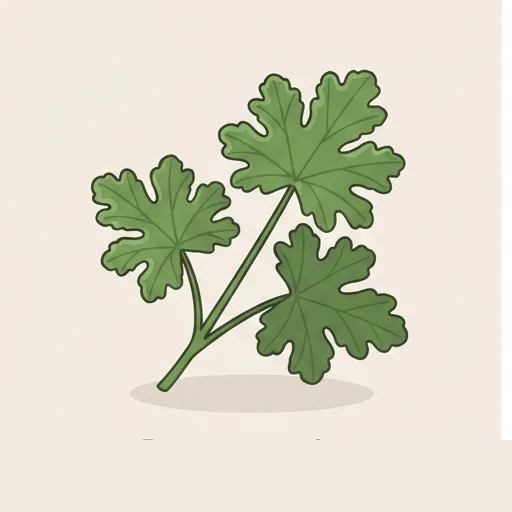
Rose geranium is the leaf of Pelargonium graveolens, a plant distilled for its essential oil, unrelated to true geraniums.
What it tastes like
On the nose: lavender, floral, citrus. Among its measured molecules: citronellyl formate, citronellyl propanoate, Citronellyl butyrate, aristolene, geranyl formate.
What goes with it
247 more go with it. See them all in the full library →Salt and acid
Salt
Salt not measured yet.
Acid
Acid not measured yet.
Unusual pairings
Pairs the library can cite that almost nobody makes.
- Rose geranium + Lemon thyme
both carry geranyl acetate, lavender (46 of 338 carry it)
- Rose geranium + Lemon balm
both carry geranyl acetate, lavender (46 of 338 carry it)
- Rose geranium + Sumac
both carry limonene, lemon (126 of 338 carry it)
46 of 91 compounds on file carry a paper the library can cite.
palmitic acidacidreads as slight characteristic taste (PubChem)Measured in 11 of 338 ingredients.cite
0.65 ± 0.00% peak area/IS area of steam-distilled fresh geranium leaf oil — Androutsopoulou et al. 2021, Pathogens (Table 1, row 'hexadecanoic acid', column 'Pelargonium graveolens')vanillinaromaphenolreads as sweetish smell (PubChem)Measured in 12 of 338 ingredients.cite
7.06 ± 1.79% peak area/IS area of steam-distilled fresh geranium leaf oil — Androutsopoulou et al. 2021, Pathogens (Table 1, row 'vanillin', column 'Pelargonium graveolens')linaloolaromaalcoholreads as spicy, citrus taste (PubChem)Measured in 91 of 338 ingredients.cite
5.2% (relative) of a commercially-sourced geranium oil — Bigos et al. 2012, Molecules (Table 1, row 'Linalool')camphenearomaterpenoidreads as camphor-like (PubChem)Measured in 19 of 338 ingredients.cite
identified by headspace GC-MS of the living leaves and stem cuttings; the table gives retention time/index and CAS number, no relative-abundance value — Wendin et al. 2023, Molecules (Table 1 (Chemical compounds found in the Pelargonium graveolens 'Dr. Westerlund' samples), row 'Camphene')alpha-pinenearomaterpenoidreads as odor of turpentine (PubChem)Measured in 71 of 338 ingredients.cite
identified by headspace GC-MS of the living leaves and stem cuttings; no relative-abundance value reported — Wendin et al. 2023, Molecules (Table 1, row 'alpha-pinene')p-cymenearomaterpenoidreads as mild pleasant odor (PubChem)Measured in 42 of 338 ingredients.cite
identified by headspace GC-MS of the living leaves and stem cuttings; no relative-abundance value reported — Wendin et al. 2023, Molecules (Table 1, row 'Para-cymene')citronellyl formatearomaesterMeasured in 1 of 338 ingredients.cite
identified by headspace GC-MS of the living leaves and stem cuttings; no relative-abundance value reported — Wendin et al. 2023, Molecules (Table 1, row 'Citronellyl formate')cyclohexanolaromaalcoholreads as camphor-like odor (PubChem)Measured in 3 of 338 ingredients.cite
identified by headspace GC-MS of the living leaves and stem cuttings; no relative-abundance value reported — Wendin et al. 2023, Molecules (Table 1, row 'Cyclohexanol')cyclohexanonearomaketoneMeasured in 2 of 338 ingredients.cite
identified by headspace GC-MS of the living leaves and stem cuttings; no relative-abundance value reported — Wendin et al. 2023, Molecules (Table 1, row 'Cyclohexanone')citronellyl propanoatearomaesterMeasured in 1 of 338 ingredients.cite
0.22 ± 0.01% peak area/IS area of steam-distilled fresh geranium leaf oil — Androutsopoulou et al. 2021, Pathogens (Table 1, row 'citronellyl propanoate', column 'Pelargonium graveolens')Citronellyl butyratearomaesterMeasured in 1 of 338 ingredients.cite
0.39 ± 0.01% peak area/IS area of steam-distilled fresh geranium leaf oil — Androutsopoulou et al. 2021, Pathogens (Table 1, row 'citronellyl butanoate', column 'Pelargonium graveolens')citronellolaromaterpenoidreads as rose odor (PubChem)Measured in 15 of 338 ingredients.cite
identified by headspace GC-MS of the living leaves and stem cuttings; the table gives retention time/index and CAS number, no relative-abundance value — Wendin et al. 2023, Molecules (Table 1 (Chemical compounds found in the Pelargonium graveolens 'Dr. Westerlund' samples), row 'Citronellol')citronellyl acetatearomaterpenoidMeasured in 4 of 338 ingredients.cite
0.14 ± 0.00% peak area/IS area of steam-distilled fresh geranium leaf oil — Androutsopoulou et al. 2021, Pathogens (Table 1, row 'citronellyl acetate', column 'Pelargonium graveolens')alpha-terpineolaromaalcoholreads as floral, lilac (PubChem)Measured in 54 of 338 ingredients.cite
identified by headspace GC-MS of the living leaves and stem cuttings; no relative-abundance value reported — Wendin et al. 2023, Molecules (Table 1, row 'Alpha -terpineol')limonenearomaterpenoidreads as pleasant lemon-like (PubChem)Measured in 91 of 338 ingredients.cite
identified by headspace GC-MS of the living leaves and stem cuttings; no relative-abundance value reported. The table's own Formula and CAS columns for this row disagree (formula printed as C9H13NO3, which is not limonene's formula; CAS 5989-27-5 is correctly D-limonene's) -- an error in the source table, recorded here under the CAS-identified compound, not the printed formula — Wendin et al. 2023, Molecules (Table 1, row 'Limonene')menthonearomaterpenoidreads as bitter (PubChem)Measured in 7 of 338 ingredients.cite
1.6% (relative) of a commercially-sourced geranium oil — Bigos et al. 2012, Molecules (Table 1, row 'Menthone')rose oxidearomaterpenoidMeasured in 3 of 338 ingredients.cite
identified by headspace GC-MS of the living leaves and stem cuttings; no relative-abundance value reported. The paper's Table 2 describes it as the 'Fragrance found in roses and rose oil' linked to the panel's rose descriptor — Wendin et al. 2023, Molecules (Table 1, row '4-Methyl-2-(2-methylprop-1-en-1-yl)tetrahydro-2H-pyran'; also named in Table 2 (Sensory attributes ... suggested chemical compounds) as the compound suggested for the 'Rose' sensory attribute)β-bourbonenearomaterpenoidMeasured in 5 of 338 ingredients.cite
1.1% (relative) of a commercially-sourced geranium oil — Bigos et al. 2012, Molecules (Table 1, row 'β-Bourbonene')delta-cadinenearomaterpenoidMeasured in 9 of 338 ingredients.cite
0.9% (relative) of a commercially-sourced geranium oil — Bigos et al. 2012, Molecules (Table 1, row 'δ-Cadinene')aristolenearomaterpenoidMeasured in 1 of 338 ingredients.cite
identified by headspace GC-MS of the living leaves and stem cuttings; no relative-abundance value reported — Wendin et al. 2023, Molecules (Table 1, row '(−)-Aristolene')geraniolaromaalcoholreads as sweet rose odor (PubChem)Measured in 26 of 338 ingredients.cite
13.4% (relative) of a commercially-sourced geranium oil — Bigos et al. 2012, Molecules (Table 1, row 'Geraniol')neralaromaterpenoidMeasured in 18 of 338 ingredients.cite
0.17 ± 0.00% peak area/IS area of steam-distilled fresh geranium leaf oil — Androutsopoulou et al. 2021, Pathogens (Table 1, row 'neral', column 'Pelargonium graveolens')geranyl acetatearomaterpenoidreads as odor of lavender (PubChem)Measured in 24 of 338 ingredients.cite
0.4% (relative) of a commercially-sourced geranium oil — Bigos et al. 2012, Molecules (Table 1, row 'Geranyl acetate')cis-rose oxidearomaterpenoidMeasured in 3 of 338 ingredients.cite
1.4% (relative) of a commercially-sourced geranium oil — Bigos et al. 2012, Molecules (Table 1, row 'cis-Rose oxide')β-caryophyllene oxidearomaetherMeasured in 19 of 338 ingredients.cite
0.24 ± 0.00% peak area/IS area of steam-distilled fresh geranium leaf oil — Androutsopoulou et al. 2021, Pathogens (Table 1, row 'caryophyllene oxide', column 'Pelargonium graveolens')caryophyllenearomaterpenoidMeasured in 50 of 338 ingredients.cite
identified by headspace GC-MS of the living leaves and stem cuttings; no relative-abundance value reported — Wendin et al. 2023, Molecules (Table 1, row 'Caryophyllene')humulenearomaterpenoidMeasured in 26 of 338 ingredients.cite
identified by headspace GC-MS of the living leaves and stem cuttings; no relative-abundance value reported — Wendin et al. 2023, Molecules (Table 1, row 'Humulene')geranyl formatearomaesterMeasured in 1 of 338 ingredients.cite
1.05 ± 0.06% peak area/IS area of steam-distilled fresh geranium leaf oil — Androutsopoulou et al. 2021, Pathogens (Table 1, row 'geranyl formate', column 'Pelargonium graveolens')alpha-guaienearomaterpenoidMeasured in 3 of 338 ingredients.cite
identified by headspace GC-MS of the living leaves and stem cuttings; no relative-abundance value reported — Wendin et al. 2023, Molecules (Table 1, row 'Alpha-Guaiene')geranyl propionatearomaesterMeasured in 1 of 338 ingredients.cite
0.46 ± 0.05% peak area/IS area of steam-distilled fresh geranium leaf oil — Androutsopoulou et al. 2021, Pathogens (Table 1, row 'geranyl propanoate', column 'Pelargonium graveolens')geranyl butyratearomaesterMeasured in 2 of 338 ingredients.cite
0.49 ± 0.05% peak area/IS area of steam-distilled fresh geranium leaf oil — Androutsopoulou et al. 2021, Pathogens (Table 1, row 'geranyl butanoate', column 'Pelargonium graveolens')phenethyl tiglatearomaesterMeasured in 1 of 338 ingredients.cite
0.34 ± 0.03% peak area/IS area of steam-distilled fresh geranium leaf oil — Androutsopoulou et al. 2021, Pathogens (Table 1, row 'phenyl ethyl tiglate', column 'Pelargonium graveolens')geranyl tiglatearomaesterMeasured in 1 of 338 ingredients.cite
1.0% (relative) of a commercially-sourced geranium oil — Bigos et al. 2012, Molecules (Table 1, row 'Geranyl tiglate')cis-linalool oxidearomaetherMeasured in 4 of 338 ingredients.cite
0.21 ± 0.08% peak area/IS area of steam-distilled fresh geranium leaf oil — Androutsopoulou et al. 2021, Pathogens (Table 1, row 'cis–linalool oxide (fr)', column 'Pelargonium graveolens')10-epi-gamma-eudesmolaromaterpenoidMeasured in 2 of 338 ingredients.cite
4.4% (relative) of a commercially-sourced geranium oil — Bigos et al. 2012, Molecules (Table 1, row '10-epi-γ-Eudesmol')gamma-eudesmolaromaterpenoidMeasured in 2 of 338 ingredients.cite
0.1% (relative) of a commercially-sourced geranium oil — Bigos et al. 2012, Molecules (Table 1, row 'γ-Eudesmol')trans-linalool oxidearomaetherMeasured in 4 of 338 ingredients.cite
0.17 ± 0.03% peak area/IS area of steam-distilled fresh geranium leaf oil — Androutsopoulou et al. 2021, Pathogens (Table 1, row 'trans–linalool oxide (fr)', column 'Pelargonium graveolens')gamma-cadinenearomaterpenoidMeasured in 5 of 338 ingredients.cite
0.6% (relative) of a commercially-sourced geranium oil — Bigos et al. 2012, Molecules (Table 1, row 'γ-Cadinene')isomenthonearomaterpenoidMeasured in 1 of 338 ingredients.cite
6.3% (relative) of a commercially-sourced geranium oil — Bigos et al. 2012, Molecules (Table 1, row 'Isomenthone')trans-rose oxidearomaterpenoidMeasured in 3 of 338 ingredients.cite
0.6% (relative) of a commercially-sourced geranium oil — Bigos et al. 2012, Molecules (Table 1, row 'trans-Rose oxide')alpha-agarofuranaromaterpenoidMeasured in 1 of 338 ingredients.cite
0.30 ± 0.14% peak area/IS area of steam-distilled fresh geranium leaf oil — Androutsopoulou et al. 2021, Pathogens (Table 1, row 'α–agarofuran', column 'Pelargonium graveolens')AromadendrenearomaterpenoidMeasured in 5 of 338 ingredients.cite
identified by headspace GC-MS of the living leaves and stem cuttings; no relative-abundance value reported — Wendin et al. 2023, Molecules (Table 1, row 'Aromadendrene')alpha-muurolenearomaterpenoidMeasured in 7 of 338 ingredients.cite
0.2% (relative) of a commercially-sourced geranium oil — Bigos et al. 2012, Molecules (Table 1, row 'α-Muurolene')α-copaenearomaterpenoidMeasured in 18 of 338 ingredients.cite
identified by headspace GC-MS of the living leaves and stem cuttings; no relative-abundance value reported — Wendin et al. 2023, Molecules (Table 1, row 'Copaene')
On file, no cited source yet ✳
These molecules are on record for it from the library's earlier sources. We are buying and requesting the papers; each one that lands moves its molecule up into the cited list.
- (R)-β-citronellolterpenoid
- propionic acidacidreads as sour & mildly cheese-like (PubChem)
- citronellic acidterpenoid
- isovaleric acidacidreads as acid taste (PubChem)
- β-phellandreneterpenoidreads as burning taste (PubChem)
- isodecanoic acidacid
- terpinoleneterpenoidreads as terpene taste (PubChem)
- 3-methyl-1-pentanolalcohol
- 3-methylcyclohexanoneketone
- (E)-2,3-dimethylacrylic acidacidreads as spicey (PubChem)
- 4-Methylpentanoic acidacid
- heptanoic acidacid
- capric acidacid
- acetic acidacidreads as pungent (PubChem)
- 1-octen-3-olalcohol
- benzoic acidphenolreads as bitter taste (PubChem)
- butyric acidacidreads as butter-fat taste (PubChem)
- capric acidacid
- myrceneterpenoidreads as pleasant (PubChem)
- salicylic acidacid
- caprylic acidacidreads as slight odor (PubChem)
- lauric acidacidreads as characteristic, like oil of bay (PubChem)
- (+)-menthoneterpenoid
- 3,7-dimethylocta-2,6-dien-1-olterpenoid
- geranic acidterpenoid
- beta-ocimeneterpenoid
- 3-Methyloctanoic acidacid
- neranic acidterpenoid
- cis-β-Ocimeneterpenoid
- kaempferol 3,7-di-O-beta-D-glucosideflavonoid
- nerolalcoholreads as sweet rose (PubChem)
- 2-methylpropanoic acidacidreads as cheesy taste (PubChem)
- 2-ethylbutyric acidacid
- 2-methylpentanoic acidacid
- α-phellandreneterpenoid
- 3-methylpentanoic acidacid
- valeric acidacidreads as fruity taste (PubChem)
- heptanoic acidacid
- 1-hexanolalcoholreads as fatty, fruity (PubChem)
- pelargonic acidacidreads as fatty odor (PubChem)
- 2-methylbutyric acidacid
- hexanoic acidacid
- isooctanoic acidacid
- 6-methyl-5-hepten-2-oneketonereads as fruity taste (PubChem)
- phenylacetic acidacidreads as floral odor (PubChem)
Sources
- Androutsopoulou et al. 2021, Pathogens
- Bigos et al. 2012, Molecules
- Wendin et al. 2023, Molecules