Rhubarb
Spice & roots· root bitter
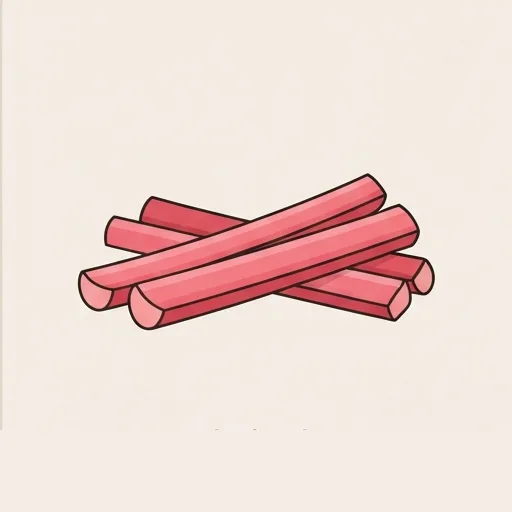
What it is
Rhubarb is the leaf stalk of Rheum rhabarbarum, eaten as a vegetable but used like a fruit; its leaves are toxic and discarded.
What it tastes like
On the nose: acid. Among its measured molecules: sorbic acid, benzoic acid, acetic acid.
What goes with it
- Cherimoyaboth carry DL-malic acidcite
- Cane sugarboth carry benzoic acidcite
- Gochujangboth carry DL-malic acidcite
Salt and acid
Salt
Sodium 4 mg per 100 g — USDA FoodData Central 167758.
Acid
Acid not measured yet.
Unusual pairings
Pairs the library can cite that almost nobody makes.
- Rhubarb + Cane sugar
both carry benzoic acid (30 of 338 carry it)
- Rhubarb + Brandy
both carry acetic acid (58 of 338 carry it)
- Rhubarb + Fermented pear juice
both carry acetic acid (58 of 338 carry it)
10 of 58 compounds on file carry a paper the library can cite.
acetic acidaromaacidreads as pungent (PubChem)Measured in 35 of 338 ingredients.cite
39.1-75.0 mg/L across the four cultivars, mean 62.0 ± 16.0 — Kharchenko et al. 2023, BioTech (Table 3, row 'Acetic')benzoic acidaromaacidreads as bitter taste (PubChem)Measured in 5 of 338 ingredients.cite
0.7-11.7 mg/L across the four cultivars, mean 6.7 ± 4.5 — the smallest and by far the most variable entry in the table (CV 67.2%), 'Krupnochereshkovy' carrying one-sixteenth of what 'Upryamets' does — Kharchenko et al. 2023, BioTech (Table 3, row 'Benzoic')citric acidtasteacidreads as strongly acidic taste (PubChem)Measured in 7 of 338 ingredients.cite
12,550-18,100 mg/L across the four cultivars, mean 15,113 ± 2852 — 81% of the total organic acid this paper measures, and the largest by an order of magnitude — Kharchenko et al. 2023, BioTech (Table 3 (Varietal differences in organic acid content in rhubarb juice, mg/L), row 'Citric')DL-malic acidtasteacidreads as sour taste (PubChem)Measured in 8 of 338 ingredients.cite
'The share of malic acid in total acid content varied between 89% and 92% in the evaluated rhubarb cultivars' — their own measurement, not a borrowed figure, and the direct contradiction of the citric-dominant reading — Mezeyová et al. 2021, Plants (Discussion, the authors' own summary of their Table 9 result)lactic acidtasteacidreads as mild acid taste and does not overpower weaker aromatic flavors (PubChem)Measured in 8 of 338 ingredients.cite
18.1-95.0 mg/L across the four cultivars, mean 57.8 ± 31.5 — a 5.2-fold cultivar range, the largest relative spread in the table (CV 54.5%) — Kharchenko et al. 2023, BioTech (Table 3, row 'Lactic')oxalic acidtasteacidMeasured in 1 of 338 ingredients.cite
1800-2520 mg/L across the four cultivars, mean 2141 ± 301 — the second largest acid, and the one that makes rhubarb leaves inedible while the petiole stays usable — Kharchenko et al. 2023, BioTech (Table 3, row 'Oxalic')succinic acidtasteacidreads as very acid taste (PubChem)Measured in 5 of 338 ingredients.cite
635-1550 mg/L across the four cultivars, mean 1071 ± 377; the widest spread of the three major acids, 2.4-fold between 'Upryamets' and 'Zaryanka' — Kharchenko et al. 2023, BioTech (Table 3, row 'Succinic')tartaric acidtasteacidMeasured in 6 of 338 ingredients.cite
20.0-52.1 mg/L across the four cultivars, mean 31.8 ± 14.1 — Kharchenko et al. 2023, BioTech (Table 3, row 'Tartaric')sorbic acidaromaacidreads as slightly acidic taste (PubChem)Measured in 1 of 338 ingredients.cite
16.8-36.2 mg/L across the four cultivars, mean 25.7 ± 8.1. Reported in the paper's own spelling; see the notes — sorbic acid is a standard preservative and its presence in a freshly pressed juice is worth treating with suspicion — Kharchenko et al. 2023, BioTech (Table 3, row 'Sorbinic')vitamin Ctasteacidreads as pleasant, sharp, acidic taste (PubChem)Measured in 3 of 338 ingredients.cite
125.0-164 mg/L across the four cultivars, mean 140.3 ± 16.8 — the tightest range of any acid in the table (CV 12.0%) — Kharchenko et al. 2023, BioTech (Table 3, row 'Ascorbic')
On file, no cited source yet ✳
These molecules are on record for it from the library's earlier sources. We are buying and requesting the papers; each one that lands moves its molecule up into the cited list.
- Rhaponticin 6''-O-gallate
- rheinphenol
- aloe emodinalcohol
- chrysophanolphenol
- Rhaponticin 2''-O-gallate
- parietinphenol
- Isoquercitinflavonoid
- brassinolidealcohol
- 24-Epicastasteroneterpenoid
- Piceatannol 3'-O-glucoside
- Torachrysone 8-O-Glucoside
- (3S,8S,9S,14S,17R)-17-[(2R,5R)-5,6-dimethylheptan-2-yl]-10,13-dimethyl-2,3,4,7,8,9,11,12,14,15,16,17-dodecahydro-1H-cyclopenta[a]phenanthren-3-olterpenoid
- 1-O-Feruloyl-beta-D-glucosephenol
- 1-O-(4-coumaroyl)-beta-D-glucoseacid
- Lup-20(29)-ene-2alpha,3beta,28-triolterpenoid
- Lup-20(29)-ene-2alpha,3beta,28-triol 3,28-dipalmitateterpenoid
- 2-(3,4-dihydroxyphenyl)-5,7-dihydroxy-3-[(2R,3S,4R,5R,6S)-3,4,5-trihydroxy-6-[[(2S,3S,4S,5S,6S)-3,4,5-trihydroxy-6-methyloxan-2-yl]oxymethyl]oxan-2-yl]oxychromen-4-oneflavonoid
- [(2S,3R,4S,5S,6R)-4,5-dihydroxy-2-[3-hydroxy-5-[(E)-2-(3-hydroxy-4-methoxyphenyl)ethenyl]phenoxy]-6-(hydroxymethyl)oxan-3-yl] 3,4,5-trimethoxybenzoate
- 2-(3,4-dihydroxyphenyl)-5,7-dihydroxy-3-[(2R,3S,4S,5S,6S)-3,4,5-trihydroxy-6-methyloxan-2-yl]oxychromen-4-oneflavonoid
- DL-malic acidacid
- L-malic acidacid
- DL-glutamineacid
- emodinphenolreads as orange crystals (PubChem)
- cyanidin 3-O-β-D-glucosideflavonoid
- pulmatinphenol
- resveratrolphenol
- 4-[2-(3,5-dihydroxyphenyl)ethenyl]benzene-1,2-diol
- (E/Z)-4-methoxyresveratrol
- EZ-resveratrol
- Rhaponiticin
- 1-O-sinapoyl-beta-D-glucoseacid
- stigmasterolalcohol
- isofucosterolalcohol
- isorhapontinsugar
- polydatinphenol
- Desoxyrhaponticinsugar
- isorhapontigeninphenol
- rhapontigeninphenol
- (E/Z)-rhapontigenin
- (E/Z)-isorhapontigenin
- (Z)-stilbeneflavonoid
- Deoxyrhapontin from rhubarb root
- 4-methoxyresveratrol
- Rhaponticinphenol
- piceatannolphenol
- resveratroloside
- DL-glutamineacid
- 5-[2-(3-hydroxyphenyl)ethenyl]-2-methoxyphenol
Sources
- Kharchenko et al. 2023, BioTech
- Mezeyová et al. 2021, Plants