Cocktail onion
Savory & ferment· ferment vinegar
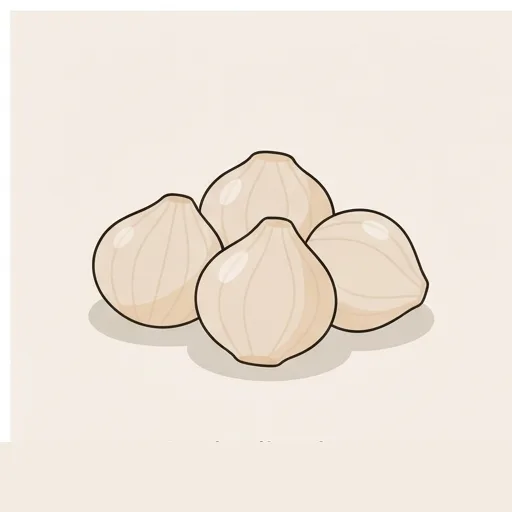
What it is
Cocktail onion is a small pickled onion, usually a variety of Allium cepa, brined in vinegar and salt.
What it tastes like
The house reads it as briny, onion ✳ — a known palate, not yet a cited measurement. Among its measured molecules: dipropyl trisulfide, 3,5-diethyl-1,2,4-trithiolane, 4,6-diethyl-1,2,3,5-tetrathiane, 3(2H)-Furanone, 2-hexyl-5-methyl-, allyl methyl trisulfide.
What goes with it
Salt and acid
Salt
Sodium 371 mg per 100 g — USDA FoodData Central 170003.
Acid
Acid not measured yet.
Unusual pairings
Pairs the library can cite that almost nobody makes.
- Cocktail onion + Asian pear
both carry dimethyl trisulfide (19 of 338 carry it)
- Cocktail onion + Cantaloupe
both carry dimethyl trisulfide (19 of 338 carry it)
- Cocktail onion + Grilled shrimp
both carry dimethyl trisulfide (19 of 338 carry it)
Every one of its 8 compounds carries a paper the library can cite.
dimethyl trisulfidearomasulfur compoundMeasured in 12 of 338 ingredients.cite
2.31 ± 3.18% of total peak area in pickled onion against 3.24 ± 3.00% fresh. This is the only row of the twenty the paper confirmed using an authentic standard in addition to retention index and MS spectral matching; the standard deviation is larger than the mean in both samples, so the number is a presence with a poorly constrained level. — Farag et al. 2019, Molecules (Table 2, row 2, 'Pickled' column; footnote a marks this row as confirmed with an authentic standard)dipropyl trisulfidearomasulfur compoundMeasured in 1 of 338 ingredients.cite
1.28 ± 2.21% of total peak area in pickled onion against 4.44 ± 1.26% fresh — down by roughly two thirds, with a standard deviation larger than the mean in the pickled sample — Farag et al. 2019, Molecules (Table 2, row 14, 'Pickled' column)allyl methyl trisulfidearomaMeasured in 2 of 338 ingredients.cite
25.25 ± 7.56% of total peak area in pickled onion against 11.48 ± 5.08% fresh — the paper records a significant increase in its level on pickling — Farag et al. 2019, Molecules (Table 2, row 8, 'Pickled' column)3,5-diethyl-1,2,4-trithiolanearomaMeasured in 1 of 338 ingredients.cite
32.08 ± 4.53% of total peak area in pickled onion against 18.95 ± 7.15% in the fresh bulb — the largest single volatile in the pickled product, and one of the two compounds the paper itself identifies as a marker for pickled onion — Farag et al. 2019, Molecules (Table 2 (Relative percentiles of volatile components to total peak areas detected in fresh and pickled onion bulb using SPME/GC-MS measurements (n = 3)), row 15, 'Pickled' column)4,6-diethyl-1,2,3,5-tetrathianearomaMeasured in 1 of 338 ingredients.cite
9.69 ± 1.13% of total peak area in pickled onion against 10.03 ± 9.17% fresh — the second cyclic polysulfur ring in the jar, and far more reproducible after pickling than before it — Farag et al. 2019, Molecules (Table 2, row 19, 'Pickled' column)3(2H)-Furanone, 2-hexyl-5-methyl-aromaetherMeasured in 1 of 338 ingredients.cite
3.44 ± 1.06% of total peak area in pickled onion against 0.42 ± 0.43% fresh — an eightfold rise, and the second of the two compounds the paper names as a marker for pickled onion — Farag et al. 2019, Molecules (Table 2, row 17, 'Pickled' column)
Sources
- Farag et al. 2019, Molecules