Flavor← the wheel
Cinchona bark
Spice & roots· root bitter
What it is
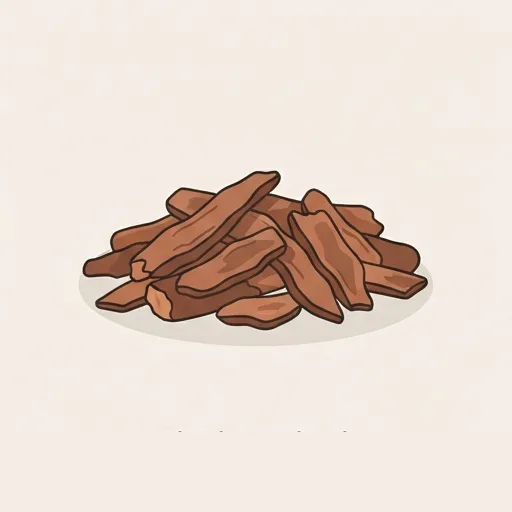
Cinchona bark is bark from Cinchona trees, native to the Andes, historically the source of an anti-malarial alkaloid and still used to make tonic water and amari.
What it tastes like
On the nose: bitter; the house adds dry, woody, tannic ✳.
Salt and acid
Salt
Salt not measured yet.
Acid
Acid not measured yet.
4 of 53 compounds on file carry a paper the library can cite.
cinchoninetastenitrogen compoundMeasured in 1 of 338 ingredients.cite
1.87% to 2.30% of the dried bark by mass — the MOST abundant alkaloid in all four Ph. Eur. batches, above quinine in every one of them — Murauer et al. 2018, Journal of chromatography. A (Table 2 (Quantitative results as determined by SFC; values reflect percent, mg alkaloid per 100 mg crude drug), row 'cinchonine (5)', across the four bark samples CC-2017-1 to CC-2017-4)cinchonidinetastenitrogen compoundMeasured in 1 of 338 ingredients.cite
0.90% to 1.26% of the dried bark by mass — always the least abundant of the three assigned alkaloids, which the paper states in its own results — Murauer et al. 2018, Journal of chromatography. A (Table 2, row 'cinchonidine (6)', across the four bark samples CC-2017-1 to CC-2017-4)quinidinetastenitrogen compoundMeasured in 1 of 338 ingredients.cite
identified by HPLC in Cinchona succirubra bark extracts as one of the four quinoline alkaloids against which the two extraction methods were compared and found qualitatively similar. NO PER-COMPOUND CONCENTRATION IS PUBLISHED in that paper — its quantitative response is a total-alkaloid yield — so this entry is an identification in the bark and nothing more. The SFC paper that quantifies the other three could separate quinidine as a standard but did not assign it in the plant material, its peaks being too small to give meaningful spectra. — Fabiano-Tixier et al. 2011, (Abstract and results, on the comparison by HPLC of quinoline alkaloids extracted from Cinchona succirubra bark by microwave-integrated extraction and leaching against conventional Soxhlet extraction)quininetastenitrogen compoundreads as very bitter taste (PubChem)Measured in 2 of 338 ingredients.cite
2.1 to 70.5 mg per L in ten commercial soft drinks and tonic waters bought from local shops, measured by paper-based fluorometry and cross-checked against a batch fluorescence method that returned 2.6 to 75.1 mg/L on the same samples — Tsaftari et al. 2023, Sensors (Basel, Switzerland) (Table 2 (Paper-based method vs. the batch fluorescence method), 'QN Found (mg L−1)' column, the ten commercial soft-drink and tonic-water samples)
On file, no cited source yet ✳
These molecules are on record for it from the library's earlier sources. We are buying and requesting the papers; each one that lands moves its molecule up into the cited list.
- Cinchonaminonenitrogen compound
- epiquininenitrogen compound
- cinchonain-ibflavonoid
- Cinchonicinolnitrogen compound
- Cinchonan-9-ol, 6'-methoxy-, (8alpha,9R)-nitrogen compound
- (+)-hydrocinchoninenitrogen compound
- (S)-[(2R,4S)-5-ethyl-1-azabicyclo[2.2.2]octan-2-yl]-(6-methoxyquinolin-4-yl)methanolnitrogen compound
- cinchonain IIaflavonoid
- Procyanidin B2flavonoid
- procyanidin B5flavonoid
- proanthocyanidin A2flavonoid
- rubiadinphenol
- 1,6-dihydroxy-2-methyl-9,10-anthraquinonephenol
- [(2S)-5-ethyl-1-azabicyclo[2.2.2]octan-2-yl]-(6-methoxyquinolin-4-yl)methanolnitrogen compound
- quinaminenitrogen compound
- 2-[2-[(2S,4S,5R)-5-ethenyl-1-azabicyclo[2.2.2]octan-2-yl]-5-methoxy-1H-indol-3-yl]ethanolnitrogen compound
- 1,6-dihydroxy-3,7-dimethoxyanthracene-9,10-dione
- 4,5-Dihydroxy-1,2,3-trimethoxyanthracene-9,10-dione
- procyanidin C1flavonoid
- cinchonain Icflavonoid
- Cinchonain IIbflavonoid
- caffeic acidacid
- cinchonidinenitrogen compound
- danthronphenol
- digiferrugineolketone
- 1,2-DIHYDROXY-3-METHYLANTHRAQUINONE
- QUINnitrogen compound
- Cinchonain-Ibflavonoid
- Purpurin 1-methyl etherphenol
- cinchonain I bflavonoid
- 3-Hydroxy-1,2-dimethoxyanthracene-9,10-dione
- alizarinphenol
- purpurinphenol
- trans-caffeic acidphenol
- hydrocinchonidinenitrogen compound
- cinchoninenitrogen compound
- conquinaminenitrogen compound
- 10-Methoxy cinchonaminenitrogen compound
- Alizarin 2-methyl etherketone
- 2-Hydroxy-1-methoxyanthracene-9,10-dione
- Quinidinonenitrogen compound
- 2-hydroxy-1,3,4-trimethoxyanthracene-9,10-dione
- 2,5-Dihydroxy-1,3,4-trimethoxyanthraquinone
- 2-Hydroxy-1,3,4,6-tetramethoxyanthracene-9,10-dione
- 6,7-Dihydroxy-1-methoxy-2-methylanthracene-9,10-dione
- 2,4,5-trihydroxy-1-methoxyanthracene-9,10-dione
- 1,2-dihydroxy-3,4-dimethoxyanthracene-9,10-dione
- quinaminenitrogen compound
- cinchonaminenitrogen compound
Sources
- Murauer et al. 2018, Journal of chromatography. A
- Fabiano-Tixier et al. 2011,
- Tsaftari et al. 2023, Sensors (Basel, Switzerland)