Caraway
Spice & roots· spice
What it is
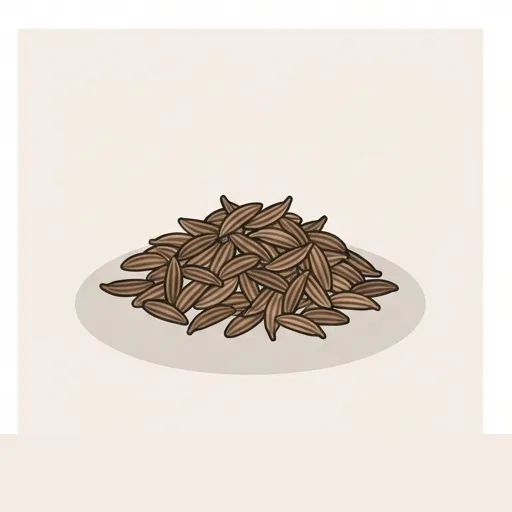
Caraway is the dried seed of Carum carvi, a biennial plant in the carrot family grown across Europe and western Asia.
What it tastes like
On the nose: cloves, citrus; the house adds thyme ✳. Among its measured molecules: sylvestrene, trans-dihydrocarvone, cis-dihydrocarvone, 2-Cyclohexen-1-ol, 1-methyl-4-(1-methylethenyl)-, trans-, carveol.
What goes with it
- Turmericboth carry p-cymenecite
- Aromatic bittersboth carry eugenol, clovescite
- London dry ginboth carry p-cymenecite
Salt and acid
Salt
Sodium 17 mg per 100 g — USDA FoodData Central 170918.
Acid
Acid not measured yet.
Unusual pairings
Pairs the library can cite that almost nobody makes.
- Caraway + Raspberry
both carry limonene, lemon (126 of 338 carry it)
- Caraway + Aromatic bitters
both carry eugenol, cloves (55 of 338 carry it)
- Caraway + Blackcurrant
both carry limonene, lemon (126 of 338 carry it)
14 of 86 compounds on file carry a paper the library can cite.
eugenolaromaphenolreads as odor of cloves (PubChem)Measured in 19 of 338 ingredients.cite
0.1% of the caraway seed essential oil — and the entirety of the paper's stated 0.1% phenylpropanoid class, i.e. the only non-terpenoid aroma compound it identifies in caraway — Ghannay et al. 2022, Plants (Table 1, phenylpropanoids block, row 12 'Eugenol', linear retention index 1358)carveolaromaterpenoidMeasured in 3 of 338 ingredients.cite
0.5% of the caraway fruit essential oil. The paper does not say which isomer, so the name is kept as printed rather than resolved by inference; the other cited paper separates trans-carveol and cis-carveol at 0.1% each. — Fekry et al. 2022, Molecules (Table 1, row 5 'Carveol', retention index 1198)carvonearomaterpenoidMeasured in 13 of 338 ingredients.cite
58.2% of the caraway seed essential oil in an independent Tunisian sample — within nine per cent of the Egyptian figure, so the dominance is not a one-harvest artefact. The paper's own class total puts oxygenated monoterpenes at 59.6%, i.e. carvone is almost the entire oxygenated fraction. — Ghannay et al. 2022, Plants (Table 1 (Chemical composition of Carum carvi L. seeds essential oil), oxygenated monoterpenes block, row 11 'Carvone', linear retention index 1242)p-cymenearomaterpenoidreads as mild pleasant odor (PubChem)Measured in 42 of 338 ingredients.cite
0.5% of the caraway fruit essential oil — the first-eluting compound the paper reports — Fekry et al. 2022, Molecules (Table 1, row 1 'p-cymene', retention time 9.995 min, retention index 1007)perillaldehydearomaaldehydeMeasured in 4 of 338 ingredients.cite
0.4% of the caraway fruit essential oil — the last of the oxygenated monoterpenes the paper reports before the wax fraction, and the same compound the citation-chase lane cleared for shiso — Fekry et al. 2022, Molecules (Table 1, row 7 'Perilla aldehyde', retention time 17.195 min, retention index 1238)trans-dihydrocarvonearomaterpenoidMeasured in 2 of 338 ingredients.cite
0.2% of the caraway seed essential oil. Note that the two papers put the cis/trans ratio the opposite way round — cis larger in the Tunisian seed, trans larger in the Egyptian fruit — which is carried visible rather than reconciled. — Ghannay et al. 2022, Plants (Table 1, oxygenated monoterpenes block, row 8 'trans-dihydrocarvone', linear retention index 1202)limonenearomaterpenoidreads as pleasant lemon-like (PubChem)Measured in 91 of 338 ingredients.cite
38.5% of the caraway seed essential oil — the second-largest constituent, and effectively the whole of the paper's stated 39% monoterpene hydrocarbon fraction. Carvone and limonene together are 96.7% of this oil. — Ghannay et al. 2022, Plants (Table 1, monoterpene hydrocarbons block, row 3 'Limonene', linear retention index 1032)3-carenearomaterpenoidMeasured in 19 of 338 ingredients.cite
0.1% of the caraway seed essential oil — Ghannay et al. 2022, Plants (Table 1, monoterpene hydrocarbons block, row 2 'D-3-carene', linear retention index 1013)myrcenearomaterpenoidreads as pleasant (PubChem)Measured in 68 of 338 ingredients.cite
0.4% of the caraway seed essential oil — Ghannay et al. 2022, Plants (Table 1, monoterpene hydrocarbons block, row 1 'Myrcene', linear retention index 993)trans-carveolaromaterpenoidMeasured in 7 of 338 ingredients.cite
0.1% of the caraway seed essential oil — Ghannay et al. 2022, Plants (Table 1, oxygenated monoterpenes block, row 9 'trans-carveol', linear retention index 1219)cis-dihydrocarvonearomaterpenoidMeasured in 2 of 338 ingredients.cite
0.7% of the caraway seed essential oil — Ghannay et al. 2022, Plants (Table 1, oxygenated monoterpenes block, row 7 'cis-dihydrocarvone', linear retention index 1195)cis-limonene oxidearomaMeasured in 3 of 338 ingredients.cite
0.1% of the caraway seed essential oil — Ghannay et al. 2022, Plants (Table 1, oxygenated monoterpenes block, row 5 'cis-limonene oxide', linear retention index 1136)sylvestrenearomaterpenoidMeasured in 1 of 338 ingredients.cite
14.8% of the caraway fruit essential oil, the second-largest constituent in that paper. This is the isomeric p-menthadiene that the other cited paper reports as limonene at 38.5%; the two are NOT merged here, because neither paper states they are the same peak and renaming would be this repo's inference rather than a source's claim. — Fekry et al. 2022, Molecules (Table 1, row 2 'Sylvestrene', retention time 10.335 min, retention index 1018)2-Cyclohexen-1-ol, 1-methyl-4-(1-methylethenyl)-, trans-aromaterpenoidMeasured in 2 of 338 ingredients.cite
0.1% of the caraway seed essential oil; its cis isomer is reported at the same 0.1% two rows later. The paper prints the locants with a full stop rather than a comma ('2.8-dien'), a European decimal convention preserved in 'as'. — Ghannay et al. 2022, Plants (Table 1, oxygenated monoterpenes block, row 4 'trans-p-mentha-2.8-dien-1-ol', linear retention index 1126)
On file, no cited source yet ✳
These molecules are on record for it from the library's earlier sources. We are buying and requesting the papers; each one that lands moves its molecule up into the cited list.
- Grycerol 2-O-fucopyranoside
- carvacrolphenolreads as thymol odor (PubChem)
- (2R,3R,4R,5S)-hexane-1,2,3,4,5-pentolalcohol
- o-tolualdehydealdehyde
- octadec-6-enoic acidacid
- (2E)-4-(acetyloxy)-3-methylbut-2-enoic acidacid
- galactitolsugar
- Junipediol A 4-O-beta-D-glucopyranoside
- 1-(2-Hydroxy-3-methoxy-5-prop-2-enylphenyl)ethanoneacid
- 4,6,6-Trimethyl-3-oxocyclohexa-1,4-diene-1-carbaldehydeterpenoid
- 4,6,6-Trimethyl-5-oxocyclohexa-1,3-diene-1-carbaldehyde
- (3S)-3-methoxy-4,6,6-trimethylcyclohexa-1,4-diene-1-carbaldehyde
- (3S)-3-hydroxy-4,6,6-trimethylcyclohexa-1,4-diene-1-carbaldehyde
- [(1R)-5-formyl-2,4,4-trimethylcyclohexa-2,5-dien-1-yl] (E)-4-acetyloxy-3-methylbut-2-enoateterpenoid
- (5R)-5-hydroxy-4,6,6-trimethylcyclohexa-1,3-diene-1-carbaldehydeterpenoid
- [(1R)-5-formyl-2,6,6-trimethylcyclohexa-2,4-dien-1-yl] (E)-4-acetyloxy-3-methylbut-2-enoateterpenoid
- d-carvoneterpenoid
- D-threitol
- alpha-terpineolalcoholreads as floral, lilac (PubChem)
- sabineneterpenoid
- erythritolreads as about twice as sweet as sucrose (PubChem)
- bergaptencoumarin
- D-fructopyranosealcoholreads as sweet (PubChem)
- 2,3,4-trimethylbenzaldehyde
- 4-coumaric acidacid
- cis-carveolterpenoid
- gallic acidacid
- methoxsalencoumarinreads as bitter taste followed by tingling sensation (PubChem)
- 5-Hydroxy-1-(4-hydroxy-3-methoxycyclohexyl)decan-3-one
- (-)-limoneneterpenoid
- (-)-carvoneterpenoid
- D-limoneneterpenoidreads as citrus odor (PubChem)
- gingerolphenol
- (+)-cis-carveolterpenoid
- (+)-trans-carveolterpenoid
- L-fucitolalcohol
- 1,3,4,9,10,10AS-Hexahydro-5,6-dihydroxy-1,1-dimethyl-7-iso-propyl-2H-9S,4AR-(epoxymethano)phenanthren-12-oneterpenoid
- 2-(3,4-dihydroxyphenyl)-5,7-dihydroxy-3-[(2S,3R,4R,5R,6S)-3,4,5-trihydroxy-6-(hydroxymethyl)oxan-2-yl]oxychromen-4-oneflavonoid
- quercetinflavonoid
- coniferinether
- kaempferolflavonoid
- petroselinic acidacid
- caryophylleneterpenoid
- beta-ocimeneterpenoid
- (R)-rosmarinic acidacid
- petroselaidic acidacid
- eleutheroside Balcohol
- 1-Ethenyl-1,2-dimethyl-4-propan-2-ylidene-2-prop-1-en-2-ylcyclohexaneterpenoid
- cis-β-Ocimeneterpenoid
- 4-(acetyloxy)-3-methylbut-2-enoic acidacid
- D-sorbitolsugarreads as sweet taste, approx 60% as sweet as sugar (wt/wt) (PubChem)
- keto-D-fructosesugar
- uridinenitrogen compound
- D-(-)-mannitolsugarreads as sweetish taste (PubChem)
- p-coumaric acidacid
- anetholetherreads as sweet taste (PubChem)
- geranialterpenoidreads as strong lemon odor (PubChem)
- γ-elemeneterpenoid
- carnosic acidphenol
- linaloolalcoholreads as spicy, citrus taste (PubChem)
- alpha-pineneterpenoidreads as odor of turpentine (PubChem)
- trans-caffeic acidphenol
- thymolphenolreads as aromatic odor (PubChem)
- eugenol acetatephenol
- protocatechuic acidacid
- (-)-Rosmadialterpenoid
- anetholacid
- 4-methylbenzaldehydealdehydereads as floral odor (PubChem)
- decanalaldehydereads as citrus odor (PubChem)
- estragoleetherreads as sweet taste reminiscent of anise (differing from anethole) (PubChem)
- (+)-catechinflavonoid
- Epirosmanollactone
Sources
- Ghannay et al. 2022, Plants
- Fekry et al. 2022, Molecules